50
- 135 AD: The End of Judaea Roman
commercial exploitation of Judaea began in earnest after the
territory became
a minor
province in 6 AD. Rome's rapaciousness
was extended into Galilee following the death of Herod Agrippa
I in 44.
His son (Herod
Agrippa II) was given the throne of Galilee in 53 and with
it, the
right to nominate the High Priest. Herod Agrippa sided with the
Romans during the First Jewish War. His sister Berenice became
the mistress of the Emperor's son and general – Titus.
Agrippa II remained a client king of Rome for many years. Vespasian rewarded
him with the rank of praetor in 75. The Herodian line died with him 97.
"Judaea was
sentenced to be portioned out to strangers
the capital was destroyed, the Temple demolished, the
royal house almost extinct, the High-priesthood buried under
the ruins
of the Temple ... The political existence of the Jewish nation
was annihilated; it was never again recognised as one of
the states
or kingdoms of the world."
– Milman (History of the Jews, p102)
Most Jews were not members of Rabbi Sauls alternative synagogues.
Very few Jews, in the 1st century, showed any interest in
a Judaised version of the Dionysian birth-and-rebirth story,
even with the embellishment of eternal life promised by the
heretical
Rabbi Saul. Within Palestine, national resistance and militancy
were in the ascendancy. In the late 40s disturbances in
Judaea
led to severe reprisals against Zealots and Nazarenes
by Roman forces.
In 52 the
situation had grown acute enough for the Roman Legate of Syria the
immediate superior of the prefect of Judaea to intervene.
But terrorism continued.
"Radical
Zealots in the late 50s began assassinating Jews who collaborated
with the Romans."
– Clouse, Pierard, Yamocuhi (Two Kingdoms, p25)
In the heartland
of Judaea many Jews were determined to raise the banner of revolt,
incensed by the ruthless avarice of successive procurators. Ironically,
the first, hopeless, war began only a few years after the triumphant
completion of the eighty-year project to build the temple precinct a
vast platform covering thirty five acres upon which stood the
Temple of Herod itself. This work at its height requiring
18,000 labourers had been permitted by the Romans,
even though the temple itself was a redolent symbol of the Nation
of Israel. Now the Romans
had to deal with that Nation.
The
Road to Massada
Riots broke out in Caesarea when, with Neros
blessing, the Greeks took control of the the city. War followed
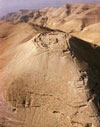
in May of 66 when the most truculent faction of Jews the Sicarii seized
Herods mountain fortress of Massada and exterminated the
Roman garrison. Encouraged by this success, Zealots in Jerusalem entered
the Temple and coerced priests into abolishing the official sacrifices
to Rome and the Emperor. Overcoming the resistance of rival factions,
opposed to war, the Zealots took control of the city and expelled
the occupying forces.
Roman troops in the province were initially caught off guard
by the fanaticism and size of the rebellion. Their initial response a
legion dispatched from Syria to retake Jerusalem was repulsed.
It was not until the accomplished general Vespasian arrived
early in 67 that Jewish successes were checked.
Samaria and
the coastal cities submitted without a fight. Then Galilee and
its cities of Jotapata and Gamala were subdued. Here, a tenacious
resistance had been led by the thirty-year-old Josephus,
although he had personally opposed the rebellion. Josephus so impressed
the Roman general that he lived to tell the tale quite literally,
in his History of the Jewish War. Subsequently, most of
the provinces of Judaea, Idumea and Peraea, including the fortresses
at Qumran and Jericho, were subdued.
However, in June 68, back in Rome, Nero committed suicide and
the imperial instability which followed three new emperors
rose and fell within the year appeared to be a sign of divine
intervention and The
Last of Days. The resistance of the revolutionaries stiffened.
Indeed,
on the island of Patmos an exiled Jew at this time was writing a fantasy
of horrors, a lurid and supposedly prophetic document, which foretold
the fall
of the Whore
of Babylon Rome and the final conflict of good and
evil (Armageddon). We know it today as Revelation. Unfortunately for
the soothsayer it was not Rome that was about to fall but the city of Jerusalem.
Vespasian,
proclaimed emperor by his troops, returned to Rome leaving his son Titus to
complete suppression of the rebels.
Fevered
Mind
About
the year 68 AD one particular revolutionist wrote
(or collected together) the book we know as the Apocalypse
of St John.
This Revelation is
the outpouring of a Jew seriously embittered by Roman
imperialism. The writer invokes retribution for his
enemies from that old, vicious god of Hebrew scripture,
who rips into humanity (the Romans) with
poetic abandon. Revelation,
and other fiery tracts of the same genre, no doubt
strengthened the resolve of first century Jewish
resistance. The rebels failed, as
did the Apocalypse in its prediction of
the imminent fall of Rome and of the Millennial Reign
that would follow.
The
anticipated ruler was a Jewish warlord, a
Christ born in Heaven, who doth judge and
make war.
This
celestial war god bore little in common with a Galilean
carpenter!
|
|
Jerusalem,
besieged by sixty thousand Roman troops in the spring of 70,
was ruthlessly retaken during
the summer, by which time the defenders had been reduced to civil
war, starvation and (according to Josephus) even cannibalism.
The
religious fanatics made their last stand at the fortress they
had taken first Massada. When faced by
inevitable defeat (in 73) they met it with a defiant act of mass
suicide.
The terrible
price the Jews paid for their revolt was the total destruction
of
their temple and the city in which it stood.
No
Temple – Now what?
A
conciliatory Vespasian now
emperor allowed a Pharisee, Johanan ben Zakkai, a pupil
of Gamaliel, to set up an academy
at Jabneh (Jamnia) in Syria in 76 and even
to
re-establish the Jewish council,
the
Sanhedrin.
But it was
only Pharisaic (or now, rabbinic )
Judaism that survived. The temple and the city of Jerusalem had
been reduced to a pile of rubble.
Yet even in
this dark hour the
rebellious spirit never left the Jews, so convinced were they of
their messianic hopes. Even in the late 70s the province of
Cyrenaica
(in north Africa) smouldered.
We know in graphic detail
the course of the first Jewish War because remarkably
the history recorded by Josephus
somehow survived. Whereas whole libraries of antiquity were
torched by the Christians, curiously, this testimony of a Jew made
it through the centuries. A subsequent work by Josephus,
The Antiquity of the Jews, which iterated and extended
his story of the 'chosen people' also survived.
The survival of these
two overlapping works was no coincidence because they rather too
well 'confirm' from a 'non-Christian source' the existence of the
godman.
In short, sometime
in the 4th century, while most else of ancient scholarship
was being
thrown into bonfires, a Christian scribe probably Eusebius,
Bishop of Caesarea 'rescued' the histories of Josephus and
doctored them to provide convenient 'proof' that Christ had been
flesh-and-blood and was neither a fiction, as pagan critics maintained,
nor solely a spiritual being, as gnostics reasoned.
Copyright © 2004
by Kenneth Humphreys.
Copying is freely permitted, provided credit is given to the author
and no material herein is sold for profit.
|