Christianity
was the ultimate product of religious
syncretism in the
ancient world. Its
emergence owed nothing to a holy carpenter.There were many Jesuses but
the fable was a cultural construct.
The nativity yarn is a concatenation of nonsense. The genealogies of Jesus, both Matthew's version and Luke's, are pious fiction. Nazareth did
not exist in the 1st century AD – the area
was a burial ground of rock-cut tombs.
With
multiple authors behind the original gospel story it
is no surprise that the figure of "Jesus" is
a mess of contradictions.
Yet the story is so thinly
drawn that being a "good Christian" might mean almost anything.
The 12
disciples are as fictitious as their master,
invented to legitimise the claims of the early churches.
The original Mary was not a virgin, that idea
was borrowed from pagan goddesses. The pagan world knew all
about virgins getting pregnant by randy gods: The Mythical "Virgin Mother".
Scholars have
known all this for more
than 200 years but priestcraft
is a highly profitable business and finances an industry of deceit to keep the show on the
road.
"Jesus
better documented than any other ancient figure"?Don't believe a word of
it. Unlike the mythical Jesus,
a real historical
figure like Julius Caesar has a mass
of mutually supporting evidence.
It
is intuitively satisfying to think that someone was
behind the towering legend. Yet like the worship of
Horus or Mithras a human life was neither
necessary nor helpful.
As it happens, we have an excellent witness to events in Judaea in the first half of the first century AD: Philo of Alexandria (c. 25 BC-47 AD). Yet Philo says not a word about Jesus or
Christianity!
Nothing
in the 'Christian message' was original. Brotherly
love and compassion had been taught
by the Stoics for centuries. The Christian
faith was a
vulgarised paganism, set to the theme of the Jewish
prophets and debased
by religious intolerance.
The early
Christian sects attacked each other as energetically
as they attacked pagans. 1st
century Palestine had rabbis,
radicals and rebels in abundance. But a
'life' conjured up from mystical fantasy, a mass
of borrowed quotations, copied story elements and
a corpus of self-serving speculation, does not
constitute an
historical reality.
The final
defeat of
militant Jewish nationalism and the eradication
of the Jewish
kingdom gave the incipient Christian churches the
final uplift they required.
A
closer look at the glib assertion that the Jesus
story "got off the ground quickly and spread
rapidly."
There
never was just one Christianity. Out of the milieu
of religiosity that infected the Roman world, dozens
of competing
and conflicting Jesus/Sun-god/Mystery cults emerged.
The first
believers in
Jesus maintained he was an ethereal spirit, much like
other sky/sun-gods. Only later did he acquire a human
death, a human life and finally a human birth.
The
composite 'Jesus Christ' character – god,
man, king, carpenter, conqueror, peace-maker, dispenser
of justice, advocate of love – was assembled
to try to unify a fragmented and fractious messianic
religious movement.
In
the mid-2nd century the Jewishness of the faith
was purged but apologists
had little
to say about a human Jesus. They took comfort
in noting similarities between their own ideas and
pagan myths.
The Christians
remained a minority until well after one
particular faction formed a political alliance
with the Roman State.
The orthodox creed remained
unpopular for centuries and persecution of its critics was necessary
to impose its will.
Many
currents fed the Jesus myth, like streams and tributaries
joining to form a major river.
Through the centuries, the
Christian godman has been made
and remade.
Egypt provided many of the themes
and much of the detail. From the age of the
Ptolemies, Alexandria was
the ancient cooking pot of religious fusion. Here, Hellenised
Judaism influenced the early Christians.
From Egypt, Catholicism copied its rituals
and ceremonies, including relics,
demonology, and monasticism. The Patriarchs
of Alexandria wrote much of Catholic theology
and it was probably in Alexandria that a profound
and detailed Buddhist
influence impressed itself
upon the faith.
From Persia, too, came a Saviour
God and notions of rebirth,
a Mithraic
dress rehearsal for Christianity, triumphant
in Rome but fatally weakened by its exclusion of
women. In Judaea itself, hatred for the Roman conquerors
bred a genre of apocalyptic
curses, anticipating
an end of the world.
Much
of the mythology of Christianity is a rehash of
an older and even more transparent fabrication – Judaism.
The
Israelites did not come from Egypt – a palpable
myth – but emerged
from the local population. There was no ancient
'Jewish Empire': the Jewish priests drew their inspiration
from the empire
of the Assyrians and
"Judaism" was a reaction to the loss of the
northern kingdom and an instructive period spent in
Babylon. Yahweh, the god fashioned by the Jews, was a brutal tyrant, a being with a
humanoid personality and a disturbing blood-lust.
Say hello to G-D!
With God's blessing, misogynistic
Jewish scribes encoded a raft of sex crimes which sanctified
racial ambition. The sacred mission was to populate
and subdue the earth. Judaism bequeathed its unfortunate
mix of ignorance and intolerance to a wayward faction
of heretics known to the world as Christians.
Jerusalem
in 10th century BC had
been barely a village of huts and cave
dwellings. Kings
David and Solomon are
purely mythical characters – warrior/priest
heroes, invented in the 6th century BC. Temples on the Mount? From "Threshing Floor" to "Noble Sanctuary". Persians and Greeks bearing gifts. Herod's Temple - Fact or Fantasy? Temple of Jupiter – Biggest and Best? Herod vs. Hadrian. Herod's trademark city of Caesarea actually owes more to Hadrian than it does to the Jewish king.
Herod
the Great was a real king – but he did not
massacre any babies. He was an astute and successful
ruler. The Herodians and the Jewish elite became
Romanised but religious fanatics led an armed
resistance which ended in catastrophes under Titus, Trajan, and Hadrian.
In the aftermath, a collaborationist revision of
Judaism, later attributed to a 13th apostle "Paul",
allegedly of impeccable Pharisaic credentials,
competed fiercely with a reconstituted rabbinic
Judaism which fused piety with mercantile
success.
Eye
Witness Reports?
Human
ingenuity and cunning is matched by mankind's
equally monumental credulity and wishful thinking.
There are actually some
200 gospels, epistles and other ancient documents concerning
the life of Jesus Christ. Writing
such material was a popular literary form, particularly
in the 2nd century. The pious
fantasies competed with Greek romantic fiction. Political
considerations in the late 2nd century led to the
selection of just four approved gospels and the rejection
of others. After three centuries of wrangling 23
other books were accepted by the Church as
divinely inspired. The rest were declared 'pious
frauds'. In truth, the whole lot belongs to a genre
of literary FICTION.
Would
the Christians lie? They
said it themselves – lying
?for God! And non-Christian
testimony? – from the authentic pen of lying
Christian scribes! Would the early believers have
died for a lie? Consider the evidence for that supposed
"persecution" –
Holy Mother Church invented heroic origins!
Laugh or cry? The
pork salesman who became England's patron saint - the
fabrication of "Saint
George". Shrouded
in deceit – Leonardo
da Vinci's Last Laugh. How
a sacrilegious 'sorcerer' outwitted the priests!
Declared
fake – Official! The "James
Ossuary". How
an Israeli entrepreneur outwitted the 'experts'.
Church
organisation, authority and membership preceded
rather than followed the justifying doctrine. As
the organisation and its needs changed so has the ‘Testament
of God’ adapted accordingly.
The "Word
of God", far from being inerrant, has ever been
a work
in progress. Biblical
morality is archaic and savage. It reflects
a barbarous, pitiless age.
The priestly "protection
racket" required the criminalizing
of the whole of humanity through the doctrine
of Sin.
The gospel yarn began not with
the testimony of a disciple but with the musings
of someone who switched
the anticipated Jewish Messiah from future hope to "historic past": "Mark": Bringing
the Celestial Superjew Down to Earth.
Matthew revised Mark's story, grounding the holy hero firmly in a Jewish milieu by adding a "royal
genealogy" and "fulfillment of prophecy". "Matthew" – A
Gospel for Messianic Jews.
Ambitious bishops in Rome asserted their authority and laid claim to the Palestinian
fantasy with The Mythical "St
Peter".
From
religious policeman to grandee
of the church,
from beast fighter in Ephesus to beheading in Rome,
Paul's story has more holes than a swiss cheese.
A detailed study of the great missionary that some
say "founded
Christianity".
The
trail-blazing Christian missionary and apostle, St
Paul, appears nowhere in the secular histories of his
age. Ironically, though supposedly in Jerusalem at
the right time, he can give no witness to a historical
Jesus.
Man, Myth and Magic. Did Paul really visit the Galatians?Paul'spresence in Philippi is decidedly dubious. Rome's imperial command post in Greece was Corinth– but was it Paul's?
Paul in Athens, confounding the Greek philosophers? Not a chance!
Paul in Caesarea? – Trial and Error. Only in the Christian dreamscape are its fabricated heroes always the centre of attention.
The
later Pauline journeys, including the supposed transportation
of the apostle to Rome, are similarly
bogus. Characterized by incongruities, contradiction,
and the absurd, they are a concocted
fantasy.Most notable among them, the fishy tale of Paul's "shipwreck" on Malta.
In fact, no evidence links Paul to the major Christian churches – the story in the Acts of the Apostles is a ripping yarn.
Pauline letters certainly exist, but the epistles,
far from being genuine letters, originated in the
acrimonious doctrinal battles of the 2nd century – a
time when "pseudepigraphy" and forged
apostolic writings were weapons in the war of "Christianities".
Did Paul really invent Christianity? His theology of Christ, Parts 1 and 2.
And who is a witness to Paul? A phantom saint heads the list of "witnesses to witnesses", Ignatius the "God bearer".
In their struggle for power,
Christians waged their own "civil
war" in which a Catholic trinitarian nonsense triumphed
over Arianism. This so-called 'orthodoxy' suppressed
and persecuted its 'heretical' opposition.
The Church expropriated
the resources – both human and material – which
might have defended Roman civilization. While an
indolent army of clerics lived on the state, the
impoverished legions degenerated into a peasant
militia.
Once a particular Christianity – hierarchical
and authoritarian – became wedded
to the Roman state, it became a force of brutal
repression.
By aggressive
warfare, Christianisation of the heathen tribes followed.
In Spain, the German
lands, Britain,
and Ireland,
the despots of the Church imposed their tyranny.
A
triumphant Christianity was the active agent in
destroying knowledge and access to learning. An
ignorant and impoverished population was more readily
subjugated by Princes of the Church. The civilization that
had stretched from the deserts of Arabia to the highlands
of Scotland reverted
to a primitive village subsistence.
Remarkably, the last pagan kingdom was eradicated as late as the 15th century.
For more than a
thousand years,
the henchmen of Christ inflicted a cruel barbarism
on every community they encountered.
Women, fortunate
to be domestic slaves, might find themselves in
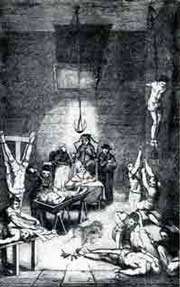
enforced celibacy, joyless marriage or burnt as a witch. Roasting
heretics became popular
entertainment and a religious duty. Fancy dress is an essential element of the religious circus.
With
a Jewish father (stern patriarch) and a Christian
mother (obsession with guilt and heaven) it is
not surprising that Islam grew up a bit of a tartar.
Early
civilizations arose in many parts of Arabia, long
before Judaism, Christianity or Islam. Islam arose as
an adaptation of old ideas, not something new.
Yet initially,
far from imposing a severe theocracy, the
early caliphs were
tolerant, even urbane.
Despite the mutual hostility of
kindred monotheisms, Islam
endorsed a great deal of Judeo-Christian theology and
adopted many of its practices. In its heyday, from the
Atlantic to central Asia, Islam produced scholars
and refinement.
When gentle Jesus
arrived in England's
North American colonies, a motley crew of venture
capitalists, criminals and self-righteous fanatics established
a precarious existence. But a
stolen land, worked by an enslaved labour force,
cultivating drug crops, could not fail to enrich the
colonial elite.
Jesus was there when the American republic
built the foundations of its economy
on slavery and was re-packaged into a convenience
Christianity suited to dreams of vast personal wealth.
JNE's 250-year list of "scholars of mythicism" updated and fully annotated with web links.
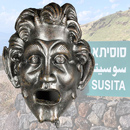
Where Jesus never walked
Just outside the ancient city of Hippos-Sussita – barely a mile from the Sea of Galilee – a large bronze mask of the god Pan came to light in November 2014. It is dated 1st/2nd century AD.
Evidence of a vibrant paganism. But of Jesus and the Christians – no evidence!
"The kingdom of heaven may be compared to a king who wished to settle accounts with his slaves … The lord released a slave and forgave his debt.
But that same slave threw his fellow slave into prison. In anger his lord handed him over to be tortured until he would pay his entire debt.
So my heavenly Father will also do to every one of you, if you do not forgive your brother or sister from your heart."
– Matthew 18.23-35
Prophet of the Lord says Jews are Canaanites!
"Thus says the Lord God to Jerusalem: Your origin and your birth are of the land of the Canaanites; your father was an Amorite and your mother a Hittite."
– Ezekiel 16.3
Jews are Canaanites – the Bible says so!
"Don't let your dinner spoil!"
We all love the "blood and sex" story of Salome's saucy dance before Herod Antipas and the head of John the Baptist turning up on a platter.
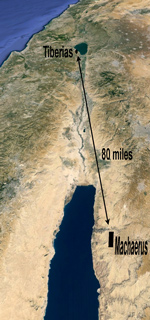
History? John was imprisoned at the frontier fortress of Machaerus, whereas Antipas would have had his dinner party at his palace in Tiberias – 80 miles away.
Sending for a take away head would have taken several days – rather longer than the interlude between the main course and the dessert!
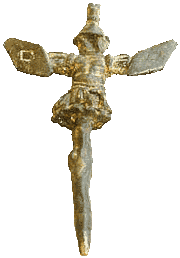
Crucifix? – No, a Roman victory Tropaeum
(2nd/3rd century, Limes Museum, Aalen, Germany).
In a Roman Triumph, captured weaponry would be mounted on a vertical stake or stauros, with a cross-member added to support shields, swords, etc.
Long before Christianity emerged from the shadows, such a "crucifix" would be carried along the Sacred Way to the Forum.
Risen or risible?
Matthew, Luke and John copied from Mark, who listened to Peter, who heard from Mary, who was told by an angel.
How's that for "eye-witness" testimony?!
God, a being of simple and bloody tastes
"One night while Moses was in camp, Jehovah was about to kill him.
But Zipporah [his wife] circumcised her son with a flint knife ... So Jehovah did not harm Moses.
Zipporah said, 'You are a bridegroom of blood'."
– Exodus 4.24-26.
Faking the evidence
Ultraviolet light reveals that a manuscript of Tacitus has been overwritten, an original "e" of chrestianos (the good) replaced by an "i" to read christianos (the Christians),
This Month
THIS WEEK
Ken presents the Top Ten reasons why Jesus is a Myth
A Talk with Jacob Berman of History Valley
NOWN
Ex-Muslim Egyptian denounces the irrational and intolerant faith that holds much of humanity in its grip.
Ever wondered why Easter is a "moveable feast" and involves the Sun and Moon in its calculation?
Does that sound like the commemoration of an event in history to you?
Barabbas! Barabbas! Twice the Rubbish After the war with Rome, the choice facing the Jews was given a human face: and Jesus was not just a lamb but an atoning goat!
A simple question for your Christian friends... Not who but WHY move the stone?
Resurrection or rubbish? Radio debate with Tony Costa
Judas– hero or zero? Villain or invented perfidious Jew?
Mary Magdalene
– Everyone's favourite
Mark -- Knowing the Unknowable!The omniscent narration betrays that the author of Mark was writing fiction, not fact.
Matthew's Mighty Makeover The miracles of Jesus were made more immediate, powerful and effortless in Matthew's redaction of Mark's text.
Enter Jesus, stage left The first of the gospels -- Mark -- was not "remembered history" but a sacred drama, fashioned after the Dionysia and introducing the new god-man Jesus.
Baptism or Baloney?Far from being "certain fact" the "baptism of Jesus" is pious fantasy supported by tendentious fraud.
Memory or Myth?
Jesus and 'mainstream' historians.
Counterfeit Christ Nothing new under the Sun.
And that applies to a hybrid Jewish saviour/ sungod called Jesus
What Sermon? What Mount? Neither original nor profound, the famous discourse supposedly given by Jesus on a mountain illustrates both the fabricated nature of his "teachings" and their failure as ethical guidelines.
Nailing Jesus - The Man Who Never Was No man behind the myth! Read more
The Christian card trick!
Shuffling the deck Read more
Jesus in Wonderland ALL the places of Jesus's mighty deeds were fictitious overlays on the true geography
'Sea of Galilee' - Fabrication of a Christian Holy Land – Read more
Is the Bible historically reliable? Ken puts the record straight!
Red Ice Radio interviews Ken Humphreys
A Talk on the World's Favourite Myth
History distorted to support
the Jesus fable
Saviour! But WHO?
Imperial Cult – Lord and Saviour of the world!
The Year 36 – So much to fit in, so little time!
Pilate: Roman hard man made a softie
Agrippa: Mild Jewish king made tyrant
Blaming Nero, a much maligned emperor. Nero's response to the fire of Rome; Roman Christians: Peter and Paul, a fable; Nero, growing up with a serial killer for a mother;
Nero, better than most; Nero as monster, the multi-layered caricature; How the Christians created a myth.
John the Baptist: marginalised for Jesus! Read more
Premier
Christian Radio Evidence for Jesus? Ken vs JP Holding Tekton Ministries Easter - 2009
Premier
Christian Radio A Historical Jesus? Ken vs Canon Michael Saward,
St Paul's
Cathedral
Did Jesus lie or was it John?
" Very truly, I tell you, the one who believes in me will also do the works that I do and, in fact, will do greater works than these, because I am going to the Father."
-- John 14.12
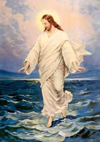
Come on Christians, let's see a few miracles – walking on water, perhaps, or raising the dead?!
Is it any surprise that organised religion
draws into itself the lonely hearts and the abandoned?
Jesus is not merely an imaginary friend, he is also a
fantasy lover.
The enthusiasts
of Christ elaborated on the Jewish notion that the body was
a source of shame and that women were an inferior breed. Mortification
of the flesh became the path of 'spiritual purity'.
But a triumphant Catholicism happily
compromised the fierce strictures of the founders for worldly advantage and predators replaced
the puritans.
The consequence is that for
two millennia Christianity's anti-sexual dogma and hypocritical behaviour have inflicted untold
damage on the mental, emotional and physical lives of
countless millions of people.
The
cost to humanity of fifteen centuries of Christian savagery – of
hundreds of millions of lives brutalised and truncated,
sacrificed to war, torture, pogrom, burning, pestilence
and plague – is incalculable.
Christianity
is the worst disaster in human history























 Bad Jesus!