OK – here's the story.
At a very young age (16?*) an Israeli guy named Oded Golan buys an ossuary from an Arab trader.
He has no idea of its value but keeps it safe for thirty five years.
Then, perchance, he arranges a viewing by a visiting biblical scholar –
the Sorbonne's Andre Lemaire – who almost immediately identifies
the inscription as referring to Jesus of Nazareth and his brother James. OK, he's a Catholic but he's a scholar, right?
Now, with an artifact literally
priceless, and reputed insured for $2 million, Oded ships his ossuary
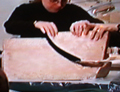
to Canada in a cardboard box lined with bubble wrap, where it arrives
in pieces. Are you buying this? Well
you better take your mother with you when you next buy a car.
"Golan himself didn't
get too excited when he heard about the cracks in his ossuary."
– Ha'aretz April 2003
Alas, for fans of the divine salvation plan, the story of this "priceless artifact" shattered as easily as the bone box itself. In December 2004, Golan was indicted as the mastermind behind an international antiquities forgery ring, operational for twenty years and with many "ancient finds" to its credit. Fakes able to fool biblical experts take a lot of skill but the religious antiquities market is especially lucrative. The world's museums vie with wealthy private collectors for that elusive evidence of "God's hand in history".
Sadly, the religiously gullible will always be with us and there will always be smart criminals ready to feed their addiction.
* PS: Israeli law changed in
1978. If an artifact was bought after this date it reverted to the state.
So when did you buy your
ossuary, sir?
NO
EVIDENCE OF JESUS?
Don't
fret – they'll manufacture it soon enough! |
Making
$millions and duping the gullible.
Warehouses
filled with artifacts of questionable origin,
Paleo-Hebraic inscriptions inscribed to
order, boxes of earth from different parts
of Israel
to make fake patinas ...
|

"King Solomon's Tablet of Stone", circa 2003. |
"The two most important biblical finds in a generation were proven to be fakes. There was no archaeological proof for the existence of Jesus Christ. There was no evidence for the existence of The Temple of Solomon."
|
|
July
21, 2003:
Ossuary
Down the Toilet!
Golan & Stencils appears in Court!

Toilet: The
'priceless' evidence of the godman finds its
true home
|
June
18, 2003:
Israel
Antiquities Authority declares James Ossuary (and Jehoash
Inscription) Fake
Well,
what a surprise! The scientific panel has reached
its verdict: FAKE. Long after the natural
processes of a damp cave environment had coated
the ossuary with "biovermiculation" and
patina, someone carved a series of letters through this
natural varnish. He then covered the freshly
cut letters with an imitation patina made from
hot water and ground chalk – a sort of
baked on "soup", microfossils and
all.
Only
advanced technology saved us from being duped
by another foolish relic. If the same scam
had been tried just fifty years ago, everyone
(well, almost everyone!) would have
had no self defense and would have accepted this nonsense as 'real proof' of the
god-man.
The
warning is clear. Expect ever more
sophisticated forgeries as the forgers master
new technologies.
|
Another
"holy relic" shows up to bolster the flagging faith
THE
"YACOB BROTHER OF YESHUA" BONE BOX
October,
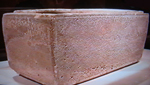
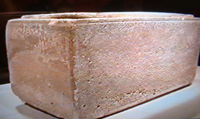
2002 – and a 50 cm long trapezoid ossuary,
or bone-box, grabs the world's headlines. |
|
Now
ossuaries are not exactly unusual – thousands have been
found. They were used for centuries to save burial space
and
sometimes held more than one skeleton. Jews not only from
Palestine but from all around the Mediterranean often had
their bones placed in ossuaries and taken to the Holy City
of Jerusalem for interment. Even inscribed ossuaries are
not particularly rare (over 200 are known) and some even
mention the name Yakov (James) or Yeshua (Jesus) –
both common names in 1st century Palestine. But this one got
star treatment.
Evidently
this particular ossuary had once contained the bones of a saint – for it was inscribed: "James,
son of Joseph, brother of Jesus."
Alerted
by scholar Andre Lemaire, an article appeared in the November-December
issue of Biblical Archaeology Review – flatly
stating that "This container provides the only New
Testament-era mention of the central figure of Christianity
and is the first-ever archaeological discovery to corroborate
Biblical references to Jesus."
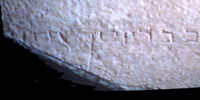
Inscribed
on the box were twenty letters of an ancient script:
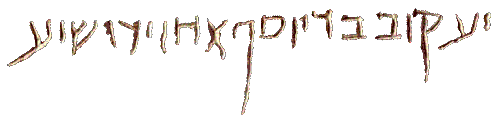 |
"Ya'akov
bar Yoseph achui d Yeshua"
(Reading
right to left) |
The
Jewish collector who possessed the ossuary – Oded Golan
– had not recognize its value, said Lemaire, because
to him, "Jesus was known as the son of God, so he
had no brother", an "unusual attitude for a
Jew". Nonetheless, the collector had kept the box safe
through thirty five turbulent years of Israeli history. But
then bizarrely, the ossuary was shattered into several pieces
on its flight to Ontario. After repair by staff of the Royal
Ontario Museum the ossuary went on public display.
Andre
Lemaire had very quickly concluded that "very probably"
the inscription referred to Jesus of Nazareth. He dated the
ossuary and its inscription rather precisely to 63 AD, a date
consistent with the inscription's cursive style of Aramaic
– which only occurs from 10 - 70 AD – and the "known
fate" of James, the brother of Jesus. The death of James
the Just is assigned by Christians to the year 62
CE. After a year of rotting down, the bones of James would
have been ready for his box.
The
ossuary itself has no inscribed date and cannot be precisely
dated by any other means.
Lemaire's
positive judgement was endorsed by such worthies as Jesuit
Joseph Fitzmeyer of the Catholic University of America, the
renowned Hebrew scholar Professor Frank Moore Cross (of Dead
Sea Scrolls fame) and Hershal Shanks and the conservative
ideologues of BAR.
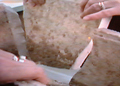
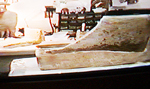
Display of the ossuary at the Royal Ontario Museum - 2002
After
the Ontario showing, the ossuary was shipped back to the Israel
Antiquities Authority which has appointed two separate
commissions to inspect the object. Before they could report,
a hugely successful Discovery Channel program was aired
at Easter/Passover 2003, followed by the inevitable book.
The myth of the James' bone box is in the public domain, whatever
science may have to say.
Lack
of provenance
A
worrying aspect of any archaeological find is a lack of
known
custody – and no one is sure where this bone box came
from. Oded Golan – after searching through "35 year
old memories" – belatedly recalled that the dealer
who sold him the ossuary had told him that it had been unearthed
from a cave in the Silwan area. Silwan is an Arab
village on the outskirts of Jerusalem. The "best guess" history
of the ossuary therefore is a story of pure conjecture:
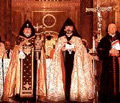 |
Armenian
Legend |
62 AD James is thrown from the Temple wall by his
opponents. He is intered in a rock-cut tomb in the
nearby Kidron valley; a year later his dried bones
re-intered in his ossuary. A tomb complex, impressive
memorial and chapel grow up around his grave. 7th century.
Muslim invaders arrive, Armenian monks run off with
the bones. The fate of the bone box is unknown. |
| |
|
–
Hang on a minute, wasn't James was stoned to death?
The stoning apparently followed the 100' fall! Now
that's dead... |
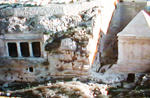 |
Rock-cut
tomb site |
–
Could it be here that the bone box slept away twenty
centuries? |
| |
|
 |
A chapel
for James? |
1960. John Allegro leads dig at "St James' Chapel".
No inscribed "James" ossuary found –
but Bedouin could have sneaked in, looted the bone
box & sold it to a dealer ??!! |
| |
|
The
Scientific Tests
If
lack of provenance were not disturbing enough, the ossuary
was first shipped to the Geological Survey of Israel
(GSI), rather than to an acknowledged expert on ancient
Jewish ossuaries, such as, say, Dr. Levi Rahmani. The GSI
was able to authentication certain aspects: Dr Richard Bauckham
(University St Andrews), working for the GSI, concluded that
the box itself was of limestone from the senoan period
(senoan chalk of the Menuha Formation?) typical for
the area of Jerusalem – but then again, commonly exposed
in many places in Israel, the Mediterranean area and parts
of Europe.
The
GSI also conducted electron microscopy tests on the
box that appeared to prove the inscription was not added at
a later date: no traces of modern elements could be found.
Energy dispersal spectrometry showed calcite, silica etc.
consistent with Jerusalem clays. Ultraviolet spectrum analysis
by the ROM revealed no fake patina (a thin sheen that forms
on stone over time).
But
the GSI could not comment further on the all-important inscription.
The
norm would have been for peer review and examination of
the
ossuary from a variety of disciplines. Instead, the ossuary
was rushed out of Israel before those who could offer an
authoritative
opinion even saw the artifact – and into the global
fanfare.
Be
that as it may, a number of specialists did eventually
get
an opportunity to comment.
Forgers
are often well skilled in reproducing artifacts. They are
as expert as the scholars. Motivation? Millions of dollars
for the collectors, a resounding endorsement for all those
who profit from the business of religion.
The
Inscription
1.
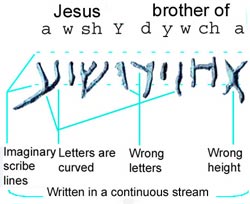
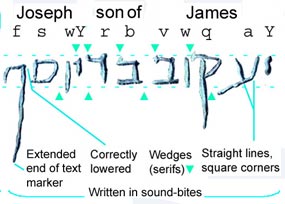
Two different hands, two different scripts?
Ancient
Writing Specialist 1.
"The
bone-box is original; the first inscription, which is in
Aramaic, 'Jacob son of Joseph,' is authentic. The second
half of the inscription, 'brother of Jesus' is a poorly
executed fake and a later addition."
– Rochelle I. Altman Final
Report on the James Ossuary
| |
 |
|
 |
| |
FAKE
(3rd - 4th century?)
|
|
|
AUTHENTIC
•
extensively cleaned?
Source:
Roger Viklund (Sweden):
|
|
•
incorrect spelling
• incorrect letter sizes
• line not straight
• a conglomeration of unrelated graphs from across
the centuries, not a coherent script
• hurried? |
2.
A contrived reference?
Ancient
Writing Specialist 2.
"The
spelling on the Jacob ossuary is 2nd - 7th CE Galilean
Aramaic according to Flesher and Basser, both of whom
are experts on the dialects of Aramaic."
Ossuary
inscriptions usually ran something like: "Judah son
of Johanan, son of Jethra," and do not include a
brother's name. In fact, such a reference is almost unknown;
the only other known example of reference to a brother
has similarities uncannily like the James inscription, even
to an untrained eye. Could this inscription have been used
as the template?
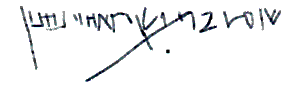 |
Shimi,
son of Asiya, brother of Hanin
(L. Y. Rahmani, A Catalog of Jewish Ossuaries,
no. 570, ). |
The
individual "Hanin" is historically unknown – an
observation which rather undermines the claim
that it was the very illustriousness of "brother Jesus" that
prompted the inclusion of his name on the ossuary!
Moreover,
a rare Aramaic spelling is common to just these two inscriptions
which mention a brother – almost as if someone
had the catalog in front of them when they inscribed the James
ossuary...?
Did
Jesus even have a brother? Most Christians never thought
so.
If he did, it rather shakes the "perpetual virginity" of
Mary, though that idea was dreamed up in the 4th
century (see:
Mary, Mary... Immaculate Deception). It is a sectarian
view that Jesus had siblings, which makes the reference to
'brother of Jesus' look contrived, 'planted' in order
to prove a point.
3.
The lost frame? Too careful placement?
An
original excised frame around the first part of the inscription
has been removed to fit in the last, faked part, i.e., "brother
of Jesus." Moreover, says Rochelle Altman:
"Contrary
to all other known ossuaries where little attention
is paid to the placement of the inscription, here the placement
is clearly carefully calculated, and the first part of the
inscription is balanced in proportion to the overall size
of the box. This careful balance has been disturbed by
the second part of the inscription."
4. Altered Technique?
Ancient
Writing Specialist 3.
"So
it seems clear that the inscription was cut with two hands:
the one of the inscription's first half which held the chisel
parallel to the stone surface and cut straight down and
the other which held it at an angle and used the corner
as a point to incise lines of uneven depth or to move along
the surface."
– Paul Flesher Observing
the Ossuary
5.
The Wrong Script?
Its
odd that an orthodox Jew – such as the James character
– would have his epitaph written in Aramaic, the language
of the northern kingdom, as opposed to Hebrew, which was that
of Judea and of "true" Jews. Educated Jews may
have settled on Greek possibly, but not Aramaic.
Possibly,
the forger supposed – as have millions of Christians – that an historical Jesus spoke Aramaic, and therefore
so would his purported sibling James. In order for the inscription
to appear "authentic" to Christian tradition, it
was written in Aramaic.
6.
On the wrong side?
Though
inscriptions can appear on any side of an ossuary (depending
in part how they are to be stored), one side of this bone
box has feint traces of incised Herodian rosettes. The inscription
however appears on the 'back'.
7.
The Box: Old – but how old?
Carbon-dating,
used to date organic remains, has an error factor of
+ or -150 years. But nothing can date stone even that accurately.
The ossuary, quite obviously ancient, could date from two
or three hundred years either side of Jesus's purported
existence. Canaanites, Israelites, Hebrews and Jews all used
ossuaries back to at least the Second Temple Period and continued
to do so for several centuries into the Common Era. The site
of Hederah in northern Israel even yielded some ossuaries
with the exact shape as the "James' ossuary".
(Encyclopedia of Archaeological Excavations in the Holy
Land , II, 496.).
"Moreover,
the lid does not fit the ossuary, suggesting that this is
not the original lid. It is a flat lid a couple of inches
in thickness."
– Paul Flesher Observing
the Ossuary
8.
Scratches above not below inscription
Much
of the box shows the 'weathering' effects of dirt, stains,
discoloring, etc. It also has extensive scratching:
'The
inscription would be underneath these scratches if it had
been on the box at the time of burial, but the majority
of this inscription is on top of the scratches. And
the sharpness of some of the letters doesn't look right
- sharp edges do not last 2,000 years.'
–
Dr. Daniel Eylon (Professor of Engineering, University of
Dayton)
9.
That patina again
Despite
'passing' the ultraviolet spectrum analysis test, patina is
easily faked (Professor Baruch Halpern of Penn State). In
any event, there is no way to distinguish between a patina
which is, say 500 years old, and one which is 2000 years old.
But is there the necessary layer of patina...?
"Biovermiculation
is limestone erosion and dissolution caused by bacteria
over time in the form of pitting and etching. The ossuary
had plenty, except in and around the area of the inscription.
This is not normal. The patina consisted of the appropriate
minerals, but it was reported to have been cleaned off the
inscription. This is impossible since patina cannot be
cleaned off limestone with any solvent or cleanser since
it is essentially baked-on glass. It is possible to forge
patina, but when it is, it cracks off. This appears to be
what happened with the ossuary."
–
John Lupia, art historian
An analysis
of the patina also revealed the
presence of Tel Aviv tap water.
Golan would artfully claim at his trial that this was because
"his mother had scrubbed the
ossuary, not realizing its value."
10.
Probability: Lies, Damn Lies, Statistics ...
Professor
Camil Fuchs (Tel Aviv University) has calculated that thousands
of individuals called Joseph, Jesus and James
would have lived in 1st century Palestine, at least 3000 of
them called James. However, the incidence of a James
with a father called Joseph and a brother called Jesus
boils down, it seems, to just 3. That's close enough to conclude
that the inscription on the bone box refers to James the
Just and his divine god-man brother Jesus of Nazareth.
However,
if we are dealing with a doctored inscription, we need
consider only how many men called James had a father called
Joseph – and that could be several hundred.
An suitable bone box would not be such a rare find.
The
doubts about the trumpeted "authenticity" multiply.
Yet there can be no doubt that forgery has been the lifeblood
of Christianity from its very beginning. With mediaeval
fakes
so readily exposed by modern science should we not expect
that same science to be used to fabricate ever more subtle
forgeries?
But
at least we have an admission that, if this were to be
the
first, then there is no other evidence of our illustrious
god-man ... !!
Further sources:
Nina Burleigh, Unholy Business: ATrue
Tale of Faith, Greed and Forgery
in the HoIy Land (Collins, 2008)
|
 |

|
|
Some fifty articles are now available as a book.
For your copy order:

|
|
Copyright © 2005
by Kenneth Humphreys.
Copying is freely permitted, provided credit is given to the author and no
material herein is sold for profit.
|

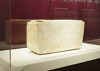
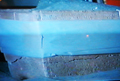
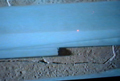
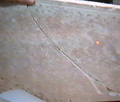 Large cracks...