A Tale of Four Cities
 |
 |
 |
 |
9th century urbanisation
Charlemagne
ran his 'empire' from a village in Germany. Constantinople
had a falling population within its ancient walls, devoted
to piety and ritual.
Cordova was an up-and-coming 'university'
town in Moorish Spain and Baghdad a thriving metropolis
of an empire which ran from the Atlantic to central Asia.
|
Charlemagne's Aachen |
Umayyad Cordova |
Byzantine
Constantinople |
Abbasid Baghdad
1cm = 5km |
'Hellenization'
of Muslim Intellectuals
Just as the
Greek empire of Alexander, 1500 years earlier, the new world
order of Islam brought together a diverse heritage – Indian
mysticism, Persian art, Greek science, Roman pragmatism, Christian
artisans
and Jewish traders. It was a crucible for innovation.
During the
darkest of Christian centuries – the 9th and 10th – a
confident, expansive Islamic empire nurtured an 'enlightenment'
which preserved and extended much of classical knowledge. Urbane
caliphs patronized art and science and encouraged the translation
of classical literature. Muslim intellectuals adapted knowledge
to the needs of Islam, but for the most part they were free to
explore
wide horizons and made inventions and discoveries unimagined
in Christendom.
While Europe
sank under vicious Christian despotisms, wrote nonsense-filled
'Lives of the Saints' and wrangled over the dating of
Easter, scholars in the new cities of Islam established the basis
for modern science and mathematics.
In this springtime
of Islam – confined to the later Umayyad and early
Abbasid dynasties – Muslim scholars began a serious
study and analysis of the science of antiquity.
For eight
hundred years Arabic would remain the major intellectual and
scientific
language of the world.
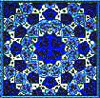
Mathematics
Modern mathematics was virtually
invented by Islamic scholars.
It was a useful discipline for
an empire of merchants.
|
|
|
780-850 The
mathematician Muhammad ibn-Musa al-Khwarizmi writes 'ilm aljebr
wa'Imuqabalah' ('the science of reunion and equation'),
using ancient Greek and Indian source books.
From 'al-Khwarizmi' algorithm is
derived; from 'al jeb'r algebra;
from 'jayb' sine.
The Hindu 'sunya' ('empty') becomes the Arabic 'sifr' which
in turn becomes the European zero in
the 15th century, vital to the further advancement of mathematics.
'Sifr' is also
the source
of the word cipher.
In the
9th century Thabit
bin Qurrah applies algebra to the
solution of geometrical problems.
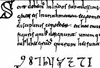
c 900 Arabs introduce decimal
(base 10) numbers into Spain (recorded in the Codex Vigilanus,
976).
1010-1075 Arab Ahmad al-Nasawi ('al-
Muqni'fi al Hisab al-Hindi') writes about Hindu calculation
of fractions, square and cubic
roots.
Early 15th century Al-Kashi writes Key
to Arithmetic.
Christian Europe:
In 1130 Adelard of Bath translated an Arabic copy of Euclid's
'Elements'. 300 years later Johannes Campanus – chaplain
to Pope Urban IV – published a fresh translation
(1482).
In the 13th
century Italy, Leonardo Fibonacci
introduced Arabic numerals and 10-based
notation ('Liber abaci' 1202; 'Liber
quadratorum' 1225) from al-Khwarizmi's work.
Gerbert
of Aurillac – later, the 'scientist
pope' Sylvester II ! – wrote about
them.
1335 saw the first
original European work on mathematics – Richard
of Wallingford writes work on trigonometry. |
|
Codex Vigilanus |
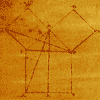
Euclid's Elements (3rd century BC) |
Cordova
versus Baghdad
Arab
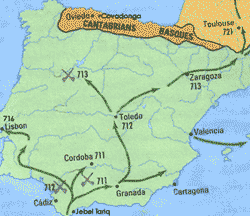
Conquest of Hispania – A 5 -Year Wonder
About
200,000 Goths ruled an indigenous population of about eight
million Hispano-Romans. And yet the Arab/Berber
armies overran the peninsular with breathtaking speed.
|
|
Rapid
Muslim success was due in no small part to the
brutality and divisions of the Christian-Visigothic
kingdom. The Gothic aristocracy was riven by
rivalry; the indigenous Hispano-Romans were treated
as second-class citizens; heretics and Jews were
penalised and persecuted.
Half
the population was said to have perished from
famine and plague during the reign of Visigothic
king Erwig (680-686).
When
the Muslim invaders arrived many Roman cities
were already disappearing under subsoil, irrigations
systems had fallen into disuse and the extensive
Roman mining
industry abandoned. The Arab armies followed
the Roman roads to reach the major cities and
as often as not left Jewish garrisons in command.
In the decisive battle of the River Guadalete
in 711 a Berber army of 12,000 defeated a force
several times its size but made up of ill-treated
slaves led by a treacherous nobility. Visigothic
King Roderick was never seen again.
|
|
Umayyads
When the Umayyad
dynasty of Damascus were murdered en masse by the Abbasids in
750, one Umayyad prince – Abed Al-Rahman I –
escaped to the distant Muslim province of al Andaluse (Spain).
Here he re-established
Umayyad rule in an independent and enlightened
emirate. His lavish court life nurtured a 'golden age'
of Islam in Spain which lasting nearly 300 years
(756-1031). In 929, in a challenge to the weakening Abbasids
in Baghdad and rival Fatamids in north Africa, emir
Abd al-Rahman III proclaimed himself caliph.
Cordoba,
his capital, was Europe's greatest city for more than two hundred
years, not only in population
but also in the richness of its cultural and intellectual life.
In the 10th century the city's Jewish Academy and Talmudic
school – headed
by
a wealthy Jew in the diplomatic in the service of the caliph, Hasdai
Ibn
Shaprut – eclipsed
the Babylonian academies of Sura and Pumbeditha. Muslim rule continued
in a shrinking al Andaluse for
another 600 years.
In the Spain
of the Umayyads, Christians and Jews (known as the 'Mozarabes')
enjoyed the same liberties as the Muslims, prospered in commerce
and were admitted into the
schools and universities.
On
the Bones of Giants
Corduba/Cordova was the largest city of Roman, Visigothic and Umayyad
Spain. The Great
Mosque of Cordova (begun in 784 and eventually
as large as St Peters in Rome) was the wonder
of the medieval world. Hundreds of marble,
granite and onyx columns – spoil
from the local Roman temple and other more
distant sites – were mounted by
stunning double arches and held a ceiling of
cedar.
Converted
to a cathedral by Ferdinand in 1236 the building
was safe – and used by both Christians and Moslems –
for 300 years. But then Christian fanaticism
in the 16th century vandalised the structure.
A monstrous Gothic 'cathedral' was raised in
the centre of the great prayer hall, a 300'
high belfry replaced the minaret, and most
of the many doors were sealed shut, making the structure
gloomy inside and uninviting from the outside. But
for local protest, Christian fanatics would
have demolished the whole thing.
| |
Double Take
Mosque
to the left, cathedral to the right!
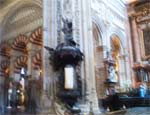
A
peeved Emperor Charles V, expressed regret
for the ill-conceived pious vandalism.
"You have built here what could have been built as well anywhere else;
and you have destroyed what was unique in the world."
|
|
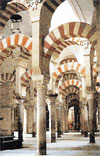
The Mezquita or
Great Mosque (showing its best side).
Predictably, the mosque
was built on the site formerly occupied by a Visigothic
church and before that, a Roman temple. |
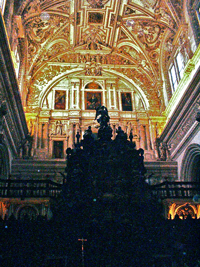
The bizarre cathedral-within-a-mosque.
The city of Cordova had a special place in Christian triumphalism. When
Constantine I seized the Roman throne in 312 his
theological advisor was Hosius, Bishop of Cordova. |
|
| |
|
Abbasids
The triumphant
Abbasid dynasty relocated the centre of Islam from the ancient
city of Damascus in Syria to a new city of Baghdad in Iraq. Here
the new overlords of Islam, Arabs themselves, became increasingly Persianized
In 832 the
astute caliph al Mamun – a patron of the Mutazilites – established
a 'House of Wisdom' for the purpose of translating
Greek and Latin science texts into Arabic. The choice of texts
for translation was a privilege of the ruling class, with astrology (astronomy)
ranked highest for its reputed powers of 'prediction'; alchemy (chemistry)
promised the creation and control of wealth; and medicine the
alleviation of suffering. This initial focus on 'useful' texts
in time gave way to greater latitude for translators to select
the best examples of abstract knowledge. Al Mamun also established
an observatory at Jundeshapur. The new 'university' which had
come into being served as a model for al-Azhar ('the
splendid')
mosque/seminary of Cairo (969) and the earliest medieval universities
in the West.
Centuries
later, the barbarian Christian kingdoms of Europe acquired
the science and technology developed by the empires of Islam.
By the end of the 13th century, universities had been established
in Paris, Bologna, Padua, Ghent, Oxford, and Cambridge. The
Renaissance and European imperial conquest became possible.
In a tragic
irony, the Islamic world, trapped in oligarchic theocracy, stultified
further development and began centuries of stagnation and decline.
| |
England's
"Muslim" Coinage
|
| |
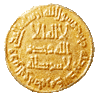
Original: 8th
century Umayyad gold Dinar
By
the mid-8th century Muslim traders had excelled
Roman merchants, crossing the Sahara and establishing
themselves as far south as Ghana where they exchanged
salt for gold; and crossing the Gobi and establishing
themselves in Canton, China. |
| |
Christian Europe:
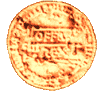
Copy: A gold coin of 8th
century Saxon King Offa of Mercia (757-796)
England's Muslim coinage with Arabic inscription: in Kûfic
script the coin proclaims 'OFFA REX' but also 'Muhammad
is the Apostle of Allah'.
Should we be surprised?
Charlemagne (771-814), Offa's illustrious contemporary,
was using the Greco-Egyptian deity Serapis on his
official seal. |
|
Astronomy: the oldest
of sciences
The
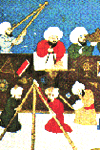
sophisticated instruments which made possible the European
voyages of
discovery, such
as the astrolabe, the quadrant, and accurate navigational
maps, were all developed by Muslims.
Arab astronomers
built on the knowledge known in antiquity and dominated
astronomy for over a thousand years.
|
|
|
Early in the 9th century, an
observatory was founded in Jundeshapur, south-west Persia.
Also, during the 9th century al-Khwarizmi draws up astronomical tables.
|
Ptolemy's Geography
|
|
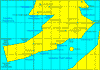
In 827 Hajjaj Ibn Mater translated
Ptolemy's Geography into Arabic.
Muslim geographers produced numerous books on the geography of Africa, Asia, India, China and the Indies from
8th to 15th centuries.
These writings included geographical
encyclopedias, almanacs and road maps. Ibn Battutah's 14th
century masterpieces provided a detailed view of the geography
of the
ancient world.
Muslim geographers and navigators learned of the magnetic
needle from contact with China and pioneer
the use of magnetic
needles in navigation.
Christian Europe:
European
navigators relied on Muslim pilots and their instruments when exploring unknown
territories. From them, the west acquired the compass and the astrolabe.
|
|
Almagest
|
|
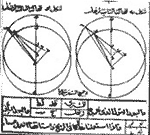
During the 9th
century Ptolemy's 'Syntaxis
Mathematica', was translated into Arabic
as the Almagest.
The Syntaxis was
the first comprehensive mathematical
study of astronomy, and used observations made everywhere
from Ceylon to Britain.
Nadir – from
Arabic 'nazir' (point of heavens directly under
observer); zenith – from 'samt
arras' (path overhead); Azimuth – the
arc from zenith to horizon – from 'assumut'.
Abu Rayhan al-Biruni (973 -1048)wrote
an elaborate astronomical treatise on the elliptical motion
of the planets and the movement of the earth around the sun,
commenting on the obliquity of the ecliptic, the precession
of the equinoxes, and the length of the solar
year.
Al-Biruni
also posits the finite nature of matter, centuries before
Lavoisier.
Christian Europe:
in the 12th century the Almagest was translated into Latin by Gerard of Cremona;
The Tables of al-Khawarizmi were translated
by Adelard of Bath, Robert of Chester and Gerard
of Cremona.
|
|
astrolabe
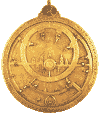
Invented
by pagan Greeks in the 2nd century BC – preserved
and improved by Arabs |
|
Arabs acquired the astrolabe from the Christian school
at Jundishapur in the 8th century and by
the 9th century had developed it into a far more sophisticated
instrument, used among other things to determine prayer
times and the orientation
of mosques towards Mecca.
In the 8th century Mashallah
bin Muhammad al Nahavandi writes
treatises on the astrolabe, the armillary sphere and the
movements of heavenly bodies.
Christian Europe:
In 1091,
Wilhelm of Hirsaw in 'De astronomia' described
Islam's astrological instruments.
In 1110
Spaniard Pedro Alfonsi brought Islamic knowledge
of astronomy tothe court of English king Henry I.
During the 12th
century the astrolabe re-entered the Christian west via Muslim Spain.
|
|
al manac

|
|
858 - 929 The
Sabian scholar Abdallah
al-Battani at Samara makes a remarkably accurate
calculation of the year (356 days, 5 hours, 46 minutes,
24 seconds). He also developed the
concept of cotangent and furnished their table in degrees.
1087 Al Zarqellu produces astronomic tables in Moorish
Toledo ('Toledan Tables') describing positions of
planets.
Christian Europe:
During the 12th
century, 'Toledan Tables' were translated into
Latin by Gerard of Cremona and were used in
Europe for the next 300 years. Users included Nicolaus
Copernicus, Tycho Brahe and Johannes Kepler
In the mid-13th
century
Roger Bacon used the Arab almanac in his major work, 'De scienta
stellerum - De numeris stellerum et motibus.'
|
|
Optics |
|
9th century: Ibn Firnas of Islamic Spain
invents eyeglasses and they are manufactured
and sold throughout Spain for over two hundred years.
965 - 1038 Al Hassan ibn al Haytham (aka 'Alhazen')
writes work on optics. He makes reference to the camera
obscura,
spherical and parabolic mirrors, study of spherical aberration,
spectrum and refraction.
Christian Europe:
In 1270, Al-Haytham translated into Latin
and influenced the work of Witelo and Kepler. 'Alhazen'
becomes the most quoted physicist of the Middle Ages.
Roger Bacon mentioned eyeglasses after studying
the work of al-Haytham whose research he frequently
referred to.
|
|
Sources:
W. Cook & R. Herzman, The Medieval World View (OUP, 1983)
B. F. Relly, The Medieval Spains (Cambridge UP, 1993)
R. McKitterk, The Early Middle Ages (OUP, 2001)
John Gribbin, Science a History (Penguin, 2003)
William Dalrymple, From the Holy Mountain (Flamingo, 1998)
N. H. H. Sitwell, Outside the Empire-The World the Romans Knew (Paladin,
1984)
Edward Gibbon, Decline & Fall, Chapters 50-52 The Coming of Islam,
Arab Conquests
M. Brett, W. Forman, The Moors, Islam in the West (Orbis, 1980)
Justin Wintle, History of Islam (Rough Guides, 2003)
J. Bloom, S. Blair, Islam - Empire of Faith (BBC Books, 2001)
J. J. Norwich, Byzantium, The Early Centuries (Viking, 1988)
C. McEvedy, The Penguin Atlas of Medieval History (Penguin, 1987)
Robert Marshall, Storm from the East (BBC Books, 1993)

|
 |

|
|
Some fifty articles are now available as a book.
For your copy order:

|
|
Copyright © 2004
by Kenneth Humphreys.
Copying is freely permitted, provided credit is given to the author and no material
herein is sold for profit. |
|