|
Sources:
|
|||||||||||
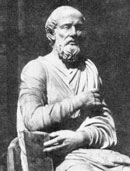
Hippolytus? (170 - 235) – Well, 16th century sculptor's idea of the philosopher anti-pope (T. Apiryon, Vatican).
Died in the Sardinian mines.
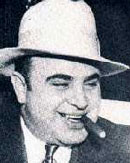
Callistus I – Tough Italian who managed the Antium operation for Rome city boss Victor (189-198).
During the long reign of Victor's successor, the simple-minded and illiterate Zephyrinus (198 -217), Callistus was the power behind the throne. He became boss of bosses when Zephyrinus died.
Interesting
Friends of Pope Callistus –
Commodus – The original 'Gladiator'
Elagabalus– something like this?
" Damasus and Ursinus, being both immoderately eager to obtain the bishopric, formed parties and carried on the conflict with great asperity, the partisans of each carrying their violence to actual battle, in which men were wounded and killed ... Ultimately Damasus got the best of the strife by the strenuous efforts of his partisans. It is certain that on one day one hundred and thirty-seven dead bodies were found in the Basilica of Sicininus, which is a Christian church .... I do not deny, when I consider the ostentation that reigns at Rome, that those who desire such rank and power may be justified in labouring with all possible exertion and vehemence to obtain their wishes; since after they have succeeded, they will be secure for the future, being enriched by offerings from matrons, riding in carriages, dressing splendidly, and feasting luxuriously, so that their entertainments surpass even royal banquets. And they might be really happy if, despising the vastness of the city, which they excite against themselves by their vices, they were to live in imitation of some of the priests in the provinces, whom the most rigid abstinence in eating and drinking, and plainness of apparel, and eyes always cast on the ground, recommend to the everlasting Deity and his true worshippers as pure and sober-minded men. This is a sufficient digression on this subject: let us now return to our narrative." – Ammianus Marcellinus, Res gestae, 27.3
|
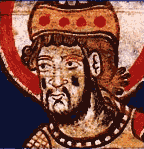
Pope Damasus I (366-385) – The ambitious gangster cleric who stole 'Christmas'.
Dead Christian Storage
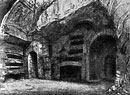
Catacomb of Callistus, Rome
The unscrupulous Pope Damasus (366-384) refurbished several catacombs into nice little earners.
He encouraged fee-paying pilgrims to visit the tombs and even exported the bones of "early Christian saints."
By the 10th century most of the skeletons had been sold off.
Jerome (well, according to a well-informed Renaissance artist).
Plagiarist!
"Translation seems to have been Jerome's forte, for he was notably less at ease with original and creative work.
Many of his commentaries on the Old Testament are drawn almost entirely from earlier commentators (despite his abuse of Ambrose for doing the same).
He was thoroughly caught out as late as 1941 when the discovery in the Egyptian desert of a voluminous five-book commentary on the prophet Zachariah by Didymus the Blind showed how heavily Jerome had relied on Didymus in his own commentary on the prophet."
– C. Freeman (Closing of the Western Mind, p281)
Jerome – 'Christian thoughts disturbed by dancing girls.'

Bloody Annals from the Church of Christ Callistus– Embezzler, Extortionist, Friend of Emperor’s Whore, Makes Pope, Dies with Transvestite!
Sex, corruption, murder – the scandal would spice up any era! But this was the Christian church before it was corrupted by power, as it waited in the wings of pagan Rome. In the late second century a bright and ambitious presbyter Hippolytus was keen to impose his own carefully thought out ideas on the Christ-followers of Rome, a church split into many rival factions. Hippolytus was a Greek-speaking theoretician, schooled under Irenaeus at Lyons and by the eastern 'apologists' like Origen. His best known work is the Refutatio Omnium Haeresium (‘Refutation of All Heresies’). His mentor, Irenaeus, had already censured Pope Victor (189-198) for arrogance towards other bishops and when Hippolytus took up residence in Rome he viewed the church there with some alarm. Victor was pressing ahead with the Latinization of the Roman Church and had excommunicated the Greek Churches of Asia Minor, ostensibly over the dating of Easter. A Greek-faction under ‘Theodotus the Money Changer’ had established an independent church in Rome which rejected the idea of the Trinity (at that time being promoted by the ruling faction), preferring the 'adoptionist' theology of 'Jesus an ordinary man on whom the Spirit descended at baptism.' In 198 Victor died but much to Hippolytus's disgust (he had hoped for the top job himself) a cleric called Zephyrinus (198 - 217) took the bishop’s chair. Hippolytus, in the first book of his Refutation – called the ‘Philosophymena’ – described Zephyrinus as ‘a simple man without education.’ In a later work called The Apostolic Tradition he complained that under Zephyrinus’s leadership church discipline had become lax, the church itself corrupt and public worship a scandal.
Turf War During Zephyrinus’s long tenure factional rivalry in the city became endemic. A group of soothsayers led by Montanus built a strong following, even among the bishop’s own entourage, and a third group, led by Sabellius, rejected the Logos and stressed the ‘modes’ of a unitary god. Hippolytus attacked them all – and Zephyrinus himself for doing nothing about it. A contemporary churchman, Tertullian in Carthage, equally austere, rallied to Hippolytus's support and censured the bishop in Rome. What really irked Hippolytus was that the new pope relied heavily on the archdeacon Callistus as his enforcer, a rough, tough Roman, who had reached the top the hard way. The contempt felt by Hippolytus became all the greater when Zephyrinus’s right-hand man followed him into the top job. The ideologue Hippolytus locked horns with the mobster, asserting a rival claim to be Bishop of Rome and for several years the two men led rival Christian gangs. Though Hippolytus was in the end to lose out, and in the process become history’s first ‘Anti-Pope,’ he took obvious delight in recording for posterity some home truths about his rival. Apparently, as a young man Callistus had been the trusted slave of a Christian master, a freedman in the imperial household called Carpophorus. In fact, Carpophorus had entrusted Callistus with considerable funds deposited by fellow-Christians for the care of widows and orphans. The money ‘disappeared’ and Callistus made a run for it. He was apprehended aboard a ship in the port of Portus. His punishment was time on a pistrinum (a hand-mill). Not long after his release, Callistus was arrested again, this time after a brawl in a synagogue where he was trying to extract money from a group of Roman Jews. Dragged before city Prefect Fuscianus, he was denounced by Carpophorus and sentenced to a penal colony, the silver mines of Sardinia. But Callistus had by this time friends in high places. He was, it seems, ‘counsellor’ to Bishop Victor and also a friend of a certain Marcia – who happened to be a concubine of Emperor Commodus. Marcia had been ‘brought up’ by the presbyter Hyacinthus before being passed on to Commodus. Unlike his intellectual father, Marcus Aurelius, the dissolute Commodus entertained a favourable opinion of the Christians and employed several in the imperial court. (Not that it did him any good – the ‘Christian’ Marcia was party to the conspiracy that strangled Commodus in 193).
Party Time Thanks to the intercession of Marcia, Callistus was soon released from Sardinia and was sent south by Victor to manage the Antium (Anzio) operation on a monthly retainer. With Victor’s death and the election of Zephyrinus, Callistus was summoned back to the capital by the new boss to manage a burial ground that the church had acquired. According to the Catholic Encyclopedia, Callistus ‘obtained great influence over the ignorant, illiterate and grasping Zephyrinus by bribes.’ With the death of Zephyrinus Callistus moved into the boss's chair. Callistus’s own time as pope (217-222) coincided precisely with the reign of that most exotic of emperors, Elagabalus. The Syrian transvestite Elagabalus, a teenager of fourteen when he came to the throne, combined outrageous bi-sexuality with a religious fanaticism. Emotionally dependent upon his mother (with whom he was sexually involved), he married, in quick succession, three older women (including a Vestal Virgin) and a male charioteer. Like Caligula and Nero before him, Elagabalus caroused for ‘rough trade’ in the streets of Rome and even solicited ‘tricks’ within the corridors of the imperial palace. Surrounding himself with a gay court, he gave high office to sexual favourites, among others, an actor (made commander of the Praetorian Guard), a muleteer (appointed imperial tax collector), and a barber. Elagabalus, like Callistus, was a High Priest – in his case, worshipping a sacred black stone (almost certainly a fallen meteorite), which he brought with him in jewel-encrusted splendour from Emesa in Syria to Rome. But he also believed himself to be that god, the living incarnation of the sun-god. He instituted an annual procession across Rome, in which Elagabalus the man ran backwards before the chariot carrying Elagabalus the stone. Dressed in silk and often a blond wig, his bizarre ‘other-ness’ demonstrated to the populace that he was no mere mortal. Rapacious taxation and wars of conquest were not for Elagabalus; his pre-occupation was to convert polytheistic Rome to an enforced monotheism. Callistus shared that goal. In keeping with the spirit of the age, Callistus was also notable for a libertine, ‘open door’ policy. Much to the disgust of Hippolytus and the austere Tertullian in Carthage (who wrote a scathing attack, ‘De pudicitia’ ), Callistus admitted ‘fornicators and murderers’ into the church, requiring of them only a statement of ‘contrition’. Like Elagabalus, Callistus came to a sudden end: he was, it seems, ‘killed in a riot.’ Perhaps this was the same riot, in March 222, which followed the assassination of Elagabalus. After the emperor’s body had been dragged through the streets, ‘a large number of Elagabalus' henchmen subsequently also met with a violent death.’ One writer reports that Callistus was murdered by a pagan lynch mob, enraged by Christian expansion in the Trastevere district (Duffy, Saints and Sinners, p14). According to legend Callistus’s body was ‘thrown into a well.’ Hippolytus (as rival pope) continued his attacks on the ruling faction – first Urban I (222-230), and then Pontianus (230-235) – until a new emperor, Maximinus Thrax, no friend of any Jesus faction, sent Hippolytus (and Pontianus!) to the Sardinian mines, where the old theologian died.
Gangster hires Pimp to write Bible! Damasus I gained the papal throne in circumstances that Christians would rather not talk about. By the second half of the fourth century the city of Rome had lost most of its imperial grandeur and competing clerics 'protected' their own territories within the city. When Pope Liberius died in 366 AD, an ambitious presbyter named Damasus had his sights on the papal throne. Unfortunately for Damasus, a rival presbyter called Ursinus got in first and had his supporters elect him pontiff. Not one to give up easily, Damasus had himself declared pope a week later, and the two rival claimants locked horns. To better his rival, Damasus had his partisans besiege the Ursinus gang, holed up in the basilica of Mary Major. Unable to break in, they climbed onto the roof of the building, forced a hole and began raining masonry onto the heads of their rivals. When the Ursinus clan capitulated after three days, one hundred and seventy seven dead and dying were brought out from the wrecked church. And thus the one true pontiff emerged. Ursinus himself, however had not been taken and the gangland rivalry would last another fifteen years, from time to time arbitrated by the pagan city prefect and forcing Damasus to move about the city with a bodyguard of armed gladiators. The charge of murder hung over Damasus for years. His name was further blackened in the eyes of many when he renounced his wife and family, supposedly to become an exemplar of clerical chastity but also to run Rome's city brothels! The philandering Damasus gained a name as the 'matronarum auriscalpius' ('ladies' ear-tickler'). From Milan, the quick tempered Emperor Valentinian, alarmed by misappropriated inheritances weakening the old patrician class, addressed a law to Damasus personally. The edict, which the emperor ordered read in all churches, forbade the clergy to frequent the houses of 'orphans and widows' or to accept further gifts and legacies.
A Silver Lining Yet the Empire's misfortune proved to be a blessing for the disgraced pope. News arrived that invading Goths had defeated the legions at Adrianople and had killed the senior emperor Valens (August 378). His preoccupied successor, Gratian, freeing himself from concerns in Italy, exempted the Bishop of Rome from secular law. With the charge of murder removed, Damasus set about redeeming his somewhat tarnished image as the Vicar of Christ. He first hit upon the idea of 'Apostolic Succession.' The incumbent Pope, he announced, was the lineal successor of St. Peter himself! Though no one had noticed it before, Peter, it seems, had been the founding Bishop of Rome! Armed with this self-elevating theory, Damasus had martyrs' tombs dug from Rome's catacombs to prove the point (and he forced 'obstinate schismatics' to pay for their restoration and adornment!). His claim gained imperial recognition: the Roman see was acknowledged as the equal of Constantinople in the definition of the faith. With his authority placed on a firmer footing, Damasus hit upon a way of ingratiating himself with the Roman public: the expropriation of the ancient mid-winter solstice festival. Damasus had found himself at the head of a faith the essence of which was resurrection, the defeat of death, by the adult Jesus, and this was marked at Easter. Yet throughout the Roman world, and especially in Rome, the great celebration was 'Natalis Solis Invicti' ('Birthday of the Unconquerable Sun') or Saturnalia, which lasted for several days and culminated in the feast of 'Brumalia' on December 25th. The immense popularity of this pagan festival – it was the major celebration of the year in fact – clearly caused agonies for the Church. The early Christians, for at least a century, had lacked even a story of a divine birth for their hero, let alone celebrated it, and as late as 245 the theologian Origen had been protesting at the very idea of celebrating the birthday of Christ 'as if he were a mere earthly king'. Damasus's artful response was to superimpose a Christian festival on the pagan one. As the early Christians had had absolutely no idea of the day, month or even year of Jesus's supposed nativity, it was a relatively easy matter to replace the birthday of one sun god by another – at precisely the same time and adopting a great deal of the pagan paraphernalia and ritual! Thus December 25th became Christ's birthday – thanks to the notorious party-loving Bishop of Rome Damasus I.
Can We Have That in Latin? Controlling 'the Word' Not long after his takeover of Saturnalia, Damasus came up with an even grander idea: a new edition of the Bible itself! Until his own pontificate the bishops of Rome had nearly all been Greek speakers. They thus had no particular problem with the version of the Old Testament scripture translated from Hebrew into Greek by the Jews of Alexandria –the Septuagint. But how much better to have a version in Latin translated directly from the Hebrew without the involvement of perfidious Jews! Latin would in future be the language of the mass. Damasus turned to a member of his entourage once notorious for his womanising and gifted with languages. Eusebius Hieronymus – a.k.a. Jerome – entered the stage of history. By all accounts Jerome was a cantankerous sleaze, despite his later emergence as a champion of self-denial. Scion of northern Italian landowners, he had originally been forced out of Rome by a sex scandal. He had organised a 'women's group' and one of its members, a girl, had died, possibly of anorexia. Indeed, 'this had been the last of a series of public scandals which dogged Jerome throughout the first half of his life.' (J. Romer, Testament, p237). Jerome had gone at first to Greece but had been so 'troubled' by his visits to the flesh pots of Corinth that he had fled to the deserts of Palestine to quieten his passions. Here were to be found many pious Christian hermits, living in squalor and seeking the divine by solitude and penance. Jerome joined them – though not quite alone. He took along three or four young boys to act as his 'secretaries.' In his letters he confessed:
Jerome spent three years in his desert retreat, receiving regular letters from rich friends in Antioch. Whatever else he got up to, he used the time to learn Hebrew, though the Jews themselves he described as 'single-hoofed, unclean animals.' He also seems to have 'worked through his problem' because he became a sour ascetic and champion of (other people's) virginity. He decried health itself as 'a sign of worldliness' and argued for bodies to be kept 'pale and hungry.' He extended the principle to personal hygiene:'He who has bathed in Christ,' said Jerome, 'does not need a second bath.' Jerome returned to Rome at a most opportune time (382) for he was just the man that Damasus needed to re-write the 'authentic' Bible, the very words of God himself. The result of Jerome's scholarly labour was the Vulgate (vulgata versio or 'common version'), the Bible in Latin that was to guide Holy Mother Church for the next thousand years. The authorship was very appropriate for the deeds that would be done in the name of Christ. Meanwhile, after a protracted wrestle with determined pagan senators, Damasus had the Altar of Victory removed from the Senate house (384) – though the statue of the goddess Victory herself was re-purposed as an angel! Gangland rivalry forced Jerome to leave Rome shortly after his boss's death in 385. The Ursinus gang, running Milan under city-boss Bishop Ambrose, got an ecclesiastical commission to order Jerome out of Rome. In the company of a couple of wealthy professional virgins he returned to Palestine. Here, at the very start of biblical tourism, he set up an extensive rural retreat and guesthouse for pilgrims. He completed further biblical revisions before his death in 420. Both the gangster Damasus and the pimp Jerome made the sainthood and, presumably, now sit at God's right hand.
Copyright © 2004
by Kenneth Humphreys.
|
|||||||||||||||||||||||||||||||||||||||||||