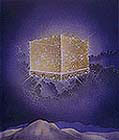
Gore-fest at the End of Time – a suitably chilling favourite to keep the credulous in line.
Holy Borg!
Apparently, Heaven is a cubic city – and the drones are Jewish virgins!
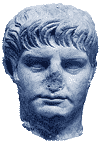
Emperor Nero (54 - 68 AD)
Of all the manic caesars surely not the worst, yet the Christians identified him as the Antichrist. His violent paranoia was felt mainly by the aristocracy.
"Year of the 4 Emperors"
Nero's downfall began in the year 67, when Julius Vindex, the governor of one of the Gallic provinces, attempted to organise a general rebellion. In May of 68, Vindex was defeated by German legions loyal to Nero but by then a governor from Spain, Galba, was marching on Rome and African legions under Clodius Macer had joined the revolt. This encouraged the senate to declare Nero a public enemy and recognize Galba as emperor. The following day, June 9, 68, Nero committed suicide.
Galba's reign was short. The German legions favoured their own commander, Vitellius, and on January 2, 69, proclaimed him emperor. In Rome, dissatisfied Praetorian Guards, bribed by the former governor of Lusitania, Otho, murdered Galba, and the senate recognized Otho as emperor on January 15, 69.
Otho's reign was even briefer than that of his predecessor. Marching north to meet the army of Vitellius, Otho was defeated at the battle of Bedriacum (near Cremona) and on April 16, 69, took his own life.
Vitellius, now recognized as emperor by the senate, would not long enjoy his triumph. The legions of Egypt and Syria favoured their own commander, Vespasian, the general sent by Nero to Judaea in 67 to crush the Jewish revolt. Crucially, Vespasian secured the support of the Danubian legions, formerly pledged to Otho. He cautiously waited in Alexandria, holding Rome's grain supply hostage, while troops loyal to him caught and killed Vitellius – December 20, 69.
Vespasian was endorsed as emperor by the senate on December 21st, 69. With his elevation to the throne, the 'conqueror of the Jews' could return to Rome, leaving his son Titus to complete the pacification of Judaea.
Another 666!
"And when the Queen of Sheba heard of the fame of Solomon ... she gave the king an hundred and twenty talents of gold, and of spices very great store, and precious stones ... And the navy also of Hiram, that brought gold from Ophir...
Now the weight of gold that came to Solomon in one year was six hundred threescore and six talents of gold ...
So king Solomon exceeded all the kings of the earth for riches and for wisdom."
– 1 Kings 10.1,23.
616?
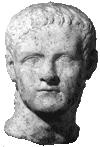
Emperor Caligula (37 - 41 AD)
Fragments from the Book of Revelation, written in Greek and dating from the late 3rd century, are slowly revealing their secrets.
They are part of a hoard of previously unintelligible manuscripts discovered a century ago in dumps outside Oxyrhynchus in Egypt.
New photographic techniques are finally deciphering the original writing.
What do they reveal? Precisely what Benary said over a century ago.
Could the Roman rascal be Caligula rather than Nero?
"This is an example of gematria, where numbers are based on the numerical values of letters in people's names. Early Christians would use numbers to hide the identity of people who they were attacking: 616 refers to the Emperor Caligula."
– David Parker, Professor of New Testament Textual Criticism and Paleography at the University of Birmingham.
(The Independent (UK), 01.05.05)
The Revelation of Saint John scarcely merits the title. Far from being a revelation, it is the most abstruse book in the whole Bible; and it was not written by any apostle called John. Indeed most of the material is secondhand, being borrowed liberally from the Old Testament books of Isaiah, Ezra, Ezekiel and, in particular, Daniel (which also has fantastic images of the End Time and refers to ‘one like a son of man’). Revelation essentially is Jewish scripture.
Revealing Truth Behind 'Revelation' Although the apocalypse does not quote directly, within its four hundred or so verses are about five hundred and fifty references to the Old Testament (B. F. Westcott and F. J. A. Hort, Greek New Testament, 184 ff.) Its core – several apocalyptic endings badly stitched together – was later given a Christian preface: a series of seven angry letters, chastising seven errant churches in western Asia Minor. Having berated the churches, Revelation then unleashes a relentless apocalyptic nightmare, badly written, repetitive and self-contradictory. In chapter after chapter, it details bizarre horrors, the supposed fate that imminently will befall the enemies of the Lord. It is the latter which gives the book its enduring popularity – a vision of the gore-fest at the End of Time. Revelation is the outpouring of a Jew seriously embittered by Roman imperialism. This fevered Jewish mind invokes retribution for his enemies from that old, vicious god of Hebrew scripture, who rips into humanity with poetic abandon. Thus, in a whole series of ‘Ends’, God releases seven ‘vials of his wrath’ (blood, plague, sores, fire, drought, etc.); sets loose four horsemen (at the head of an army of 200 million!) ‘for to slay the third part of men’ (9.15). He has his ‘demonic locusts’ torment unbelievers for five months; etc., etc. Kings, captains, false prophets and ‘the flesh of all men, both free and bond, both small and great’ are eaten by fowls that fly and are cast alive into a lake of ‘fire and brimstone.’
Proto-Christianity If nothing else, the crude, unpolished construction of Revelation, reveals early proto-Christian ideas in the process of forming. The early origin of the book is attested by its doctrinal incompatibility with the rest of the New Testament. The doctrine of the Trinity is nowhere in sight. Rather, Revelation embodies Philo’s notion of ‘multiple emanations’ – the ‘seven spirits of God’ (3.1, 5.6). Later biblical books will slim this down to a single Holy Spirit. Revelation has no dogma of ‘original sin’ ; it is idolatry which damns the mass of humanity. Baptism is not mentioned; believing Jews are ‘sealed’ not baptised. There is no reference to the Eucharist – nothing so genteel as a meal with friends mars the carnage. On the day of judgement it is ‘works’ (public action) that will count, not the Pauline ‘grace through faith’. To the author’s obvious delight, ‘Babylon’ (the Roman Empire) falls unrepentant and the vast mass of humanity perish. There is no religion of love here but only undiluted hatred and lust for revenge. In Revelation we see intermediate stages in the assimilation of preexisting, and for the most part pagan fantasy. For example, one of the godly emanations is a Christ figure, who appears in many different – and peculiar – forms. The Christ of Revelation is actually born in heaven, and under pretty extraordinary circumstances (his mother is ‘clothed in the sun, with the moon at her feet, wearing twelve stars as a crown’ – a reasonable description of Isis). This infant is going to be a bit of a Tartar:
There is no human biography at all for this Christ – he is an entirely heavenly figure, and one with some strange appendages:
Heavenly Warlord Nothing in Revelation suggests that this Christ is ever incarnated on earth. Though said to have been ‘dead , and is alive’ (2.8), the circumstances of this dying and raising are never given. In one of the first of a series of visions, Christ appears as a high priest; later in the book, he is ‘alpha and omega’ (first and last), the beginning and end of God’s creation that has existed from all eternity. He is also the ‘bright morning star’ and the ‘Lamb of sacrifice’. Christ’s primary role in Revelation, however, is as a Jewish warlord, who ‘doth judge and make war’. This celestial war god bears little in common with a Galilean carpenter!:
A primitive attempt at describing this heaven has it is as a walled city of ‘pure gold, like unto clear glass’. It is approximately half the size of the U.S.A. – ‘twelve thousand furlongs. The length and the breadth and the height of it are equal.’ (21.16)
Jewish Golden Age Through the walls of this cubic city (which are also built of ‘precious stones’) pass twelve gates, each named for a tribe of Israel. Within, God, on a great white throne, has before him a book with seven seals, and also a book of life into which he enters the name of the saved. Significantly, it is God who sits in judgement, not Christ (he gets the job in the later gospels). The ‘slain and risen’ Lamb (the Christ figure) has the job of opening each seal in turn. With the opening of the seventh seal, seven angels blast away on seven trumpets, each sound releasing a new horror – fire and blood, mountains of fire cast into the sea, a burning star falling to earth, every mountain and island displaced, etc. At one point, war even breaks out in Heaven – and it is not Christ who is the conquering hero but the Jewish archangel Michael (Israel’s national champion)!
Satan Gets Another Chance At the end of the thousand year reign (a golden age of Jewish virginity?), Satan is loosed (by God?) and now a final apocalypse wrecks havoc on humanity (presumably raised to life in order to be killed off). Remarkably, Satan’s army is still numerous:
Revelation is nothing more than virulent anti-Roman fury meant to stiffen the brethren by lurid images of their foes in torment.
Dating the Nightmare Despite internal evidence for an earlier dating, Christian scribes often choose to aggrandise their own ‘suffering’ by dating Revelation to the persecutions of Domitian about 96 AD. This ‘tradition’ began with Irenaeus at the end of the second century. Correctly understood as a Jewish resistance tract Revelation has nothing to do with later Christian suffering at all. Its core elements – the several alternative apocalyptic endings – almost certainly were in circulation in Palestine (particularly Galilee) in the mid-years of the first century, where such literature was popular. When was it written? The book itself tells us the answer, enigmatically but more precisely than any other book of the Bible:
For over a century scholars have known that Jewish numerology or ‘gematria’ resolves the name of Nero Caesar, as it appears in Hebrew (without vowels), into the number 666. Unlike the English alphabet, all the letters of Hebrew have a numerical equivalent, which opens the door to all sorts of esoteric or ‘mystical’ use. Engels credits a fellow German with the resolution of the riddle of Revelation thus:
The seven kings referred to are the emperors of Rome. At the time of writing, five are past (‘are fallen’ – Augustus, Tiberias, Caligula, Claudius, Nero), one rules still (Galba – who ruled from June 6, 68 to January 15, 69), and the prophesy is made that only one other will rule before the End. The final sentence resolves again into Nero. Could he be ‘is and is not’ (alive then dead)? How could one ‘of the seven’ be the eighth as well? The answer is that the crisis of the year 68/69 (the so-called 'year of four emperors', which ran from June 68 through to December 69) lasted long enough for rumours to spread that Nero had not died at his own hand, but had fled to Persia, had raised an army and would reclaim the throne from the interloper Vitellius. Seemingly confirming this turn of events was the appearance of an impostor on the island of Kithnos (Thermia) – about a hundred and thirty miles from Patmos – claiming to be Nero. Revelation, and other fiery tracts of the same genre, no doubt strengthened the resolve of first century Jewish resistance. The rebels failed, as did the Apocalypse in its prediction of the imminent fall of Rome and of the Millennial Reign that would follow. Many early Christians rejected the book outright, attributing authorship and the doctrine of an ‘earthly kingdom’ to a late first century Jewish Egyptian heretic called Cerinthus.
To the chagrin of many Christians ever since, Revelation nonetheless sneaked its way into the Bible, tucked away at the back and – horror fiction apart – largely forgotten. Well, forgotten that is, until the beast of American Christian fundamentalism emerged from its pit and gave the apocalyptic ravings a whole new lease of life.
Sources:
Copyright © 2005 by
Kenneth Humphreys.
|
|||||||||||||||||||||||||||||||||||||||||||||||||