"Apostle of the Lord"? No, a Romano-Greek philosopher. (Wall painting, Pompeii).
Pagans Knew Better
Truth
The egocentric Jesus reduced "truth" to his own eclectic utterances; indeed, he claimed to personify Truth itself.
In stark contrast, the Stoics affirmed the scientific method we recognize today: observations scrutinized by reason, verified and confirmed by general acceptance – that is "truth".
Pagans
"I follow the guidance of Nature - a doctrine upon which all Stoics are agreed. Not to stray from Nature and to mould ourselves according to her law and pattern - this is true wisdom. "
– Seneca, On the Happy Life, 3.
"There could be no justice, unless there were also injustice; no courage, unless there were cowardice; no truth, unless there were falsehood."
– Chrysippus of Soli (280-207 BC) (Arnold. Roman Stoicism)
"Just as the charlatans of the cults take advantage of the simpleton's lack of education to lead him around by the nose, so too with the Christian teachers: they do not want to give or receive reasons for what they believe. Their favourite expressions are "Do not ask questions, just believe!" and: "Your faith will save you!" "The wisdom of the world," they say, "is evil; to be simple is to be good."
– Celsus, On the True Doctrine.
Jesus
"Jesus saith unto him, I am the way, I am the life, I am the truth: no man cometh unto the Father, but by me." – John 14.6
"And for their sakes I sanctify myself, that they also might be sanctified through the truth." – John 17:19
"Everyone on the side of truth listens to me.
Pilate saith unto him, What is truth?"– John 18.37,38.
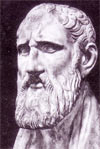
Zeno – centuries ahead of the Christians.
Pagans Knew Better
Brotherly Love
"Jesus" – often thought of as "meek and mild" – is gentle and loving only towards his adoring groupies and repentant sinners.
Towards critics and those who do not agree with him he spouts curses and invective.
In contrast to this fierce intolerance, the pagan philosophers showed far more dignity and restraint.
Pagans
"If you want to be loved, love." - Seneca, Epistulae Morales 9.
"Take care not to harm others, so others won't harm you." - Seneca, Epistulae Morale 103.
"No one can lead a happy life if he thinks only of himself and turns everything to his own purposes. You should live for the other person if you wish to live for yourself." – Seneca, Epistulae Morales 48
"When those about you are venting their censure or malice upon you or raising any other sort of injurious clamour ... it is still your duty to think kindly of them; for nature has made them to be your friends."
– Marcus Aurelius (161-180) 'Meditations'.
"We should not say ‘I am an Athenian’ or ‘I am a Roman’ but ‘I am a citizen of the Universe." – Marcus Aurelius, 'Meditations'.
" Do not, my Lucilius, attend the games, I pray you. Either you will be corrupted by the multitude, or, if you show disgust, be hated by them. So stay away."
– Seneca, Epistulae Morales 7
Jesus
"This is my commandment, That you love one another, as I have loved you." – John 15.12
" All things whatsoever ye would that men should do to you, do ye even so to them: for this is the law and the prophets." – Matthew 7.12.
"The Son of Man shall send forth his His angels, and they shall gather out of His kingdom all things that offend, and them which do iniquity, and shall cast them into a furnace of fire; there shall be wailing and gnashing of teeth." – Matthew 13.41,42
"For I am come to set a man at variance against his father, and the daughter against her mother, and the daughter in law against her mother in law. And a man's foes shall be they of his own household." – Matthew 10.35,36
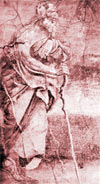
Epictetus – Greek slave made freedman in Rome, where he taught Stoicism. His wise words were recorded by Arrian and Simplicius wrote a commentary as late as the reign of Justinian.
Pagans Knew Better
Enemies
In dealing with enemies, "Jesus" vacillates between naive passivity and vindictive intransigence. The pagans had a clearer and more realistic grasp on reality.
Pagans
"Who is there among us who does not admire Lykourgos of Sparta, in his response to being blinded in one eye by a fellow-citizen. The people handed the young man over to him, to take whatever vengeance he wanted. He refrained from any retaliation in kind, but educated him and made a good man of him."
– Epictetus, Encheiridion 5."Someone gets angry with you. Challenge him with kindness in return. Enmity immediately tumbles away when one side lets it fall." – Seneca, De Ira, 2
"It's a pitiably small-minded person who gives bite for bite." - Seneca, De Ira, 11
" We shall never desist from working for the common good, helping one another, and even our enemies, till our helping hand is stricken with age." - Seneca, De Otio
"It is a denial of justice not to stretch out a helping hand to the fallen; that is the common right of humanity."
– Seneca the Elder
Jesus
"Love your enemies, bless them that curse you, do good to them that hate you, and pray for them which despitefully use you, and persecute you." – Matthew 5.44
" If a man abide not in me, he is cast forth as a branch, and is withered; and men gather them, and cast them into the fire, and they are burned." – John 15.6
“Woe to YOU, scribes and Pharisees, hypocrites! ... You serpents, you generation of vipers, how can you escape the damnation of hell?? – Matthew 23.29.33.
Seneca the Younger (4 BC-65AD)
Pagans Knew Better
Wealth
"The poor are always with us", an observation not missed by the ancient philosophers. They were fully aware at the morally corrupting influence of wealth.
Their ideal, not often realized, was an asceticism, indifferent to material possessions. "Jesus" had nothing original to add, apart from promising the poor "the kingdom of God."
They're still waiting.
Pagans
"The greatest wealth is a poverty of desires."
– Seneca, Epistulae Morales 70.
"It is not the man who has too little, but the man who craves more, that is poor."
– Seneca, Epistulae Morales 64.
"Only the person who has despised wealth is worthy of God."
- Seneca, Epistulae Morales 58.
"We are told that Jesus judged the rich with the saying 'It is easier for a camel to go through the eye of a needle than for a rich man to enter the kingdom of god.'
Yet we know that Plato expressed this very idea in a purer form when he said,
'It is impossible for an exceptionally good man to be exceptionally rich.'Is one utterance more inspired than the other?"
– Celsus, On the True Doctrine.
Jesus
"Lay not up for yourselves treasures upon earth, where moth and rust doth corrupt, and where thieves break through and steal." – Matthew 6.19
"It is easier for a camel to go through the eye of a needle than for a rich man to enter heaven."
– Matthew 19.24.
Marcus Aurelius – last of the Stoics. "For there is only one universe, one God, one law, one truth ..."
Pagans Knew Better
Slavery
"Jesus" endorses passive acceptance of slavery and an unquestioned authoritarianism. In contrast, Seneca anticipates the emancipation of slaves and the equality of men.
Pagan
" 'They are slaves,' people declare. NO, rather they are men.
'Slaves! NO, comrades.
'Slaves! NO, they are unpretentious friends.
'Slaves! NO, they are our fellow-slaves, if one reflects that Fortune has equal rights over slaves and free men alike. That is why I smile at those who think it degrading for a man to dine with his slave.But why should they think it degrading? It is only purse-proud etiquette ... All night long they must stand about hungry and dumb ... They are not enemies when we acquire them; we make them enemies ... This is the kernel of my advice: Treat your inferiors as you would be treated by your betters.
'He is a slave.' His soul, however, may be that of a free man."
– Seneca the Younger, Epistulae Morales, 47.
Jesus
"Which of you, having a slave plowing or feeding cattle, will say to him at the end of the day, when he comes in from the field, 'Go and sit down to eat?' And would not rather say to him, 'Prepare my supper, get yourself ready and wait on me while I eat and drink; after that, you may eat and drink'?
Would you thank that slave because he did the things that were commanded him? I think not. So likewise, when you have done all those things which are commanded, you should say, 'We are unprofitable slaves: we have done only that which was our duty to do.' "
– Luke 17.7,10.
|
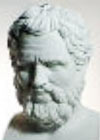
In antiquity it was not the formalistic Roman religion, with its capricious gods and part-time priests, that offered answers to the perennial questions of existence – How shall I live? How shall I face death? etc. – but the schools of philosophy. Adepts were practitioners of "the philosophical life", their maxims "medicine for the soul", their own lives exemplars of "right living". They offered moral guidance and a path of "personal growth", as well as speculations on creation, fate, and the gods. The world was not on hold, waiting for a Christian godman to teach it ethics and morality. To ancient wisdom the fabricated "Jesus" added only an insufferable egocentricity.
For five centuries, Stoicism was the dominant philosophy of the Romano-Hellenic world. Rome's educated elite found this import much to its taste. Stoicism was admirably suited to the builders of empire. It urged a dutiful self-discipline, detachment from the feckless passions, steadfastness in friendship and fortitude in adversity. It reasoned that all men were the offspring of God and therefore brothers, each deserving of compassion and justice. Stoicism made no vain promises of a life beyond the grave, though some Stoics thought it a possibility. Happiness was to be found within, in this life. Stoicism was manly, rational, and temperate. Its reward was virtue – "the highest good" – and perhaps the honour of a noble house. Stoicism originated on the island of Cyprus with Zeno of Citium at the zenith of Greek expansion in the late 4th century BC, when the old gods were already in decay and rational thought in the ascendant. It took its name from the 'Stoa', or colonnade, at Athens where Zeno taught. Though pantheistic – conjecturing God as present in all things and not transcendent – Stoicism provided many of the building blocks out of which the early Christians built their religion. Indeed, the first "pagan" Christians had trained in the Stoic tradition (Pantaenus, Clement, et al) and carried into the new faith the asceticism, seclusion, coarse dress and hirsute appearance which were all the marks of the Stoic sage on his way to "Perfection". Stoicism furnished the Christians with theory as well as practice. Zeno's primary agent of creation, a material "Mind" in the guise of an ethereal yet vivifying "fire", had by the age of Cleanthes (mid-3rd century BC), become "pneuma" or "spirit" – and would show up as the "fiery Holy Spirit" of Pentecost.
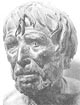
Seneca: a "Great moral teacher"
Lucius Annaeus Seneca (4 BC-65 AD) was a prodigious writer. His legacy includes satires, tragedies, several books on natural phenomena, and at least 124 insightful letters (Epistulae morales). A dozen essays on philosophy include edifying tracts on the brevity of life, human destiny, clemency and virtue. In On Clemency, Seneca describes the prince who safeguards the lives of his subjects as "god like". In On Tranquility of Mind, he urges a contentment gained from thrift rather than a ceaseless passion for wealth. A lost work De superstitione ridiculed popular conceptions of the gods. As it happens, the life of Seneca, like that of Philo, was contemporaneous with the "Jesus" of legend. Yet though Seneca wrote extensively on many subjects and people, nothing relating to "Jesus" ever caught his attention, nor does he show any awareness of a "vast multitude" of Christians, supposedly, punished for the fire that ravaged Rome in 64 AD. Seneca had a privileged upbringing. Born in Cordoba, he was the son of a famous father, Marcus Annaeus Seneca (Seneca the Elder, 54 BC-39 AD), himself a prolific writer of legal commentary, history and philosophy. Both father and son were of the Stoic school. The younger Seneca was sent to Rome as a youth, where he studied philosophy and law. He became a successful politician, but fell into disfavour when Messalina, wife of Claudius, persuaded the emperor to have him banished to Corsica. The charge was adultery with Julia Livilla, a sister of Caligula, and a rival Messalina wanted out of the way. After eight years in exile, Seneca was recalled by Claudius's second wife Agrippina and over the next several years he attained great influence as the tutor of the future emperor Nero.
Seneca - Writer of the Passion? As a leading politician (Praetor in 48, Consul in 57), Seneca was himself a witness to the intrigue and violence of the imperial court during the reigns of Caligula, Claudius and Nero. It eventually cost him his life. Though arguably compromised by his own accumulation of great wealth, Seneca remained ever the philosopher. His adaptations of Greek classics were infused with the humane and moral message of the Stoics. A favourite theme of Seneca's work was the contradiction inherent in kingship, the conflict of power with moral purpose. In Hercules Furens ("The Madness of Hercules"), one character laments crime masquerading as virtue and the triumph of might over right; another warns bloodied tyrants that they will one day face judgement. In Thyestes, the protagonists mirror the behaviour of Rome's own leaders, scheming for power and destroying each other's children in the process. Kingship is linked to a sacrificial lamb and human flesh is eaten ("Thyestian Feast"). Seneca's dramas (like the Gospels, in fact) were written to be read privately or recited at small gatherings rather than be performed. It is more than possible that the high drama of "Passion week" owes its theatrical form to the hand of Seneca. In De Ira (1.2) (about 41 AD) he writes:
Seneca has the deified Claudius wandering a comic netherworld, travelling first to "Heaven" (Mount Olympus) and from there to Hell (Hades). Dio Cassius, commenting on the "Pumpkinification", adds detail which finds a curious echo in the Gospels (the "torn curtain" of Matthew 27.50, which opened the Holy of Holies of the Temple; the swarm of "many dead that went into the city" of Matthew 27.53).
Certainly, when the tragedies of Seneca were rediscovered in the 16th and 17th century, they were immensely influential on dramatists such as Shakespeare. That a lost drama could have inspired the gospel writers should surprise no one (and here you will find a reconstruction of the "Lost Gospel of Seneca"). In 65 AD, Seneca was accused of being a part of the Calpurnius Piso conspiracy to assassinate Nero, and was forced to commit suicide. Bringing Seneca on Message The lack of any reference to Jesus Christ or Christians by Seneca was an embarrassment rectified during the 4th century by a forger familiar with Seneca's letters to his life-long friend Lucilius. What emerged was a correspondence purporting to be friendly exchanges between the eminent Roman philosopher – at the height of his fame and political influence – and an unknown itinerant preacher we now call St Paul. The catalyst for the fabrications appear to have been remarks by Tertullian, in the early 3rd century. Tertullian, aware that Seneca had articulated sentiments suited to a "great moral teacher" referred to Seneca as "often our own." By the time of Constantius II (337-361), Seneca had been taken captive by the Christians, his fidelity to the cause vouched for by a lively exchange of letters (in Latin!) with the Jewish Christian apostle. We are asked to believe that Seneca wrote eight letters to Paul and received six replies. As if.
A forger's sycophantic drivel
Extant copies of the bogus correspondence date from the 9th century, though both Jerome (de Viris Illustribus 12), and Augustine (Epistle 153.4 ad Macedonium) in the late 4th- early 5th century refer to an earlier edition. Jerome had the temerity to list Seneca among the Church "Fathers" and couples the compelled suicide of Seneca with the fabled martyrdom of Peter and Paul about the same time! Yet no one before the time of Constantius II knew of any such letters. Eusebius of Caesarea (c.263-339) – a liar for God, if ever there was one – makes reference to Paul, his "brief epistles" and Nero but says nothing of Nero's tutor and "chief minister", Seneca.
Family Connection Another dubious link to the illustrious Seneca family was made using Seneca's older brother Novatus. It seems that Novatus, who took the name of his patron Junius Gallio, served briefly as proconsul at Achaia (Greece). The 2nd century author of Acts - gleaning the name Gallio from a secular source which mentioned the proconsulship – used this tidbit of circumstantial detail for a supposed trial in Corinth of the apostle Paul before governor Gallio. The medieval Golden Legend tidied the fantasizing up nicely, with Nero witnessing Seneca's suicide after his conversion to Christianity by Saint Paul!
Seneca's brother Gallio in Delphi – but was Paul in Corinth?
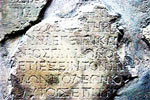
If the arrangement of the pieces is correct, and they really are from a single inscription, Junius Annaeus Gallio – elder brother of Seneca – served as proconsul in Achaia in 51/52 AD. Because Acts 18.11,12 records Paul's 18-month stay in Corinth and a "trial" instigated by local Jews before a governor called Gallio, the "Gallio inscription" is the bedrock for dating a historical Paul, indeed the entire corpus of the New Testament. There's no doubt that Seneca had an elder brother Lucius Annaeus Novatus, who adopted the name of his patron Junius Gallio. Seneca writes a flattering portrait of his brother in Natural Questions, IV and dedicates to him three books on anger management ("De Ira"). Gallio is mentioned by Tacitus (Annals, xv 73) as a "public enemy" in the wake of the abortive plot against Nero. Gallio is also mentioned by the historian Dio Cassius (155-235 AD):
Seneca himself confirms that his brother spent time in Achaia:
Appointment as proconsul and a command abroad might follow (not precede) a year as consul. It remains possible Gallio became governor in Achaia after Seneca himself returned to favour – about the year 50-52 AD. Of course, the "Gallio inscription" says nothing about Paul. The 2nd century forger of Acts need only have gleaned from one or other source the snippet of information that at some point in the past a Gallio had been consul in Greece, to construct his brief verse:
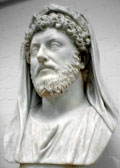
In the yarn called Acts it is really the Jews who are on trial in Corinth, not Paul, and it is the chief rabbi who gets beaten up by Greeks. "And Gallio cared for none of those things." – Acts 18.17. Ironically, Gallio's supposed refusal to punish Paul rather undermines the apologist's other argument that the early Christians were "persecuted." Last Days of Stoicism Over the course of centuries, as Stoicism developed, it became less elitist and less "indifferent" to the caprice of fate. Its concern with human issues and morality gave it new life as a popular "religion". The Stoics often found themselves at odds with imperial despots. Stoics of republican persuasion, notably Helvidius Priscus, were banished from Rome in 73 by Vespasian; and Domitian ejected all the philosophers from Italy in 89 (a "persecution" the Christian's would claim as their own). In contrast, the enlightened monarchs of the 2nd century – Hadrian, Antoninus, and Marcus Aurelius – counted themselves among the philosophers and by the time of Aurelius, the gods had assumed a more positive role as helpers and assistants. Antinous, Isis, Serapis, Jupiter and Asclepius, would all habitually appear to devotees in dreams. St Paul's apparition on the road to Damascus was nothing out of the ordinary. Yet Stoicism remained too fatalistic and too reliant upon self-discipline for a mass audience. Its ethical system was to be vulgarised by the Christians, who developed the mystical element of unseen spirits, "the Word" attendant on believers, assisting and guiding. The distinction between truth and falsehood – so vital to the Stoics – was dispensed with in order to focus more on what was perceived as "good" and "evil." Stoicism began to lose its hold on the intelligentsia with the rise of neo-Platonism and Plotinus, yet within a century neo-Platonism itself succumbed to Christian totalitarianism. The Stoic "ideal man" now became a vision ascribed to Jewish prophecy and frozen into a bogus historicism: Jesus of Nazareth, the Stoic who never lived.
Sources:
'Save' a friend e-mail this page
Copyright © 2006
by Kenneth Humphreys.
|
|||||||||||||||||||||||||||||||||||||||||||||||||||