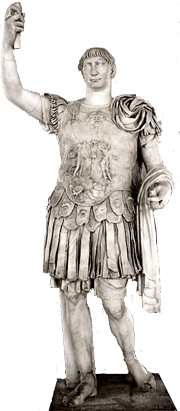
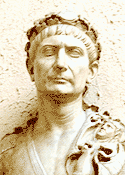
Trajan "Parthicus"
Emperor Trajan – conqueror famous for his religious tolerance as well as his military prowess.
"But anonymously posted accusations ought to have no place in any prosecution. For this is both a dangerous kind of precedent and out of keeping with the spirit of our age."
– Trajan to Pliny (Letters 10.96-97)
Trajan "Optimus"
The best man
"Trajan was most conspicuous for his justice, for his bravery, and for the simplicity of his habits ...
He didn't envy nor slay anyone, but honoured and exalted all good men without exception, and hence he neither feared nor hated any one of them ...
I know, of course, that he was devoted to boys ... yet in his relation with boys he harmed no one.
His association with the people was marked by affability and his intercourse with the senate by dignity, so that he was loved by all and dreaded by none save the enemy."
– Dio Cassius, Roman History, 68.
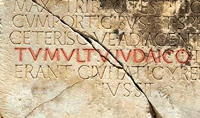
"Tumult of the Jews"
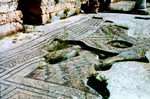
Inscription from Cyrene – a city of North Africa which had to be rebuilt after the "tumult of the Jews" in 116.
The Jewish rebellion sabotaged Rome's Parthian campaign and wrecked many cities of the eastern Mediterranean.
It was behaviour unlikely to win friends for Jews or Judaism in the Greek and Roman world.
Mosaic floors as well as many public buildings in Cyrene show signs of horrendous destruction and the Hadrianic restoration.
Jews: Spirit of Rebellion
" In the course of the eighteenth year of the Emperor [Trajan] a rebellion of the Jews again broke out and destroyed a great multitude of them.
For both in Alexandria and in the rest of Egypt and especially Cyrene, as though they had been seized by some terrible spirit of rebellion, they rushed into sedition against their Greek fellow citizens, and increasing the scope of the rebellion in the following year started a great war ... "
– Eusebius (Ecclesiastical History 4.2)
Aftermath
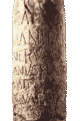
Roman milestone from Cyrene, stating that road repairs were made after
the Jewish revolt.
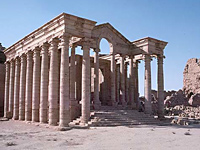
Hatra – fortress city that defeated Trajan
Hatra – home to the sun god Shamash as well as Apollo, Atargatis, Mithra, Poseidon, Eros, Hermes and Tyche.
"This city is neither large nor prosperous, and the surrounding country is mostly desert and has neither water save a small amount and that poor in quality nor timber nor fodder.
These very disadvantages, however, afford it protection, making impossible a siege by a large multitude, as does also the Sun-god, to whom it is consecrated; for it was taken neither at this time by Trajan nor later by Severus, although they both overthrew parts of its wall."
– Dio Cassius, Roman History, 68.
Corduene, Gordyene and the Kurds
The high mountain region south of Lake Van occupied by the Romans in 114 (ancient Corduene / Gordyene and hence "Kurdistan") was noted for its expertise in the construction of siege engines (Strabo, 11).
For this reason the Armenian king Tigranes used the locals for siege work – and doubtless, so too did Trajan.
"Earthquakes in divers places ... the beginnings of sorrows"
"While the emperor was tarrying in Antioch a terrible earthquake occurred; many cities suffered injury, but Antioch was the most unfortunate of all.
Since Trajan was passing the winter there and many soldiers and many civilians had flocked thither from all sides in connection with law-suits, embassies, business or sightseeing, there was no nation of people that went unscathed; and thus in Antioch the whole world under Roman sway suffered disaster.
There had been many thunderstorms and portentous winds, but no one would ever have expected so many evils to result from them.
First there came, on a sudden, a great bellowing roar, and this was followed by a tremendous quaking. The whole earth was upheaved, and buildings leaped into the air; some were carried aloft only to collapse and be broken in pieces, while others were tossed this way and that as if by the surge of the sea, and overturned, and the wreckage spread out over a great extent even of the open country. The crash of grinding and breaking timbers together with tiles and stones was most frightful; and an inconceivable amount of dust arose, so that it was impossible for one to see anything or to speak or hear a word.
And as Heaven continued the earthquake for several days and nights, the people were in dire straits and helpless ... So great were the calamities that had overwhelmed Antioch at this time."
– Dio Cassius, Roman History, 68.
The same massive earthquake caused damage as far as Rhodes and Asia Minor.
"The numerous passages of the Sibylline Oracles which repeat prophecies of similar natural catacysms which are to herald the advent of the Messiah, and the fact that Antioch was among the cities designated for destruction, as well as the personal presence of the Emperor on the scene of the catastrophe – all these evoke the possibility that the event was a signal for revolt among the Jews of the east."
– S. Applebaum, Jews and Greeks in Ancient Cyrene, p268)
In 114 Trajan swept south with his army from Armenia. The rapid Roman conquest of Mesopotamia brought nearly all Jews under Roman dominion for the first time. But at the very moment Trajan sailed in triumph on the Persian Gulf, the Jews broke into open rebellion throughout the eastern empire. The insurrection diverted troops and key officers away from the Parthian campaign and thwarted the emperor's ambitions in the east. The chosen people were to pay a terrible price for their disaffection, which in Egypt, Cyrenaica and Cyprus, as well as in the newly conquered territories, claimed many Greek and Roman lives. In cities devastated by the unexpected conflict – notably Alexandria, Edessa, Nisibis, Arbela and Antioch – a Jewish heresy would seep from the ruins – Christianity.
War in the East Early in the second century, Emperor Trajan, like a latter-day Alexander, had electrified the whole Greek world by a major campaign against the Parthians. Elevated to the purple in 98 AD, Trajan had already conquered Dacia (101-106) and had annexed Nabataea – an Arab province to the east and south of Judaea – before turning his attention to the east in 114. Trajan had several reasons for making war in Asia: a driven ego; plans for the assimilation of Armenia; a desire to free Rome’s Asian trade from dependence on Persian goodwill; and avenging the ignominious defeat of Crassus and the Syrian legions a century before. But the invasion placed a gigantic strain on the Roman state. From the first,
the Jews viewed the campaign with horror.
Many of their brethren were trading partners, living a prosperous existence
within the Parthian empire. One estimate of the number of Jews in Mesopotamia
at this time is one million (Cantor, The Sacred Chain, p61). Palestinian
Jews saw Rome’s adversary as their ally, a land
of refuge – not an enemy. A success for Rome threatened financial
ruin to Jewish merchants and Arab exporters who, as middlemen,
controlled Rome’s international trade with India and
the mysterious Land of Silk. And many Jews, despite the destruction of
their temple more than forty years earlier, clung to the old hope for a warrior-messiah, destined to
liberate Jews from Rome. An extension of Roman dominions was not what
they had in mind, quite the reverse. Rome’s preoccupation on the eastern front became a
new opportunity for rebellion. Hadrian and the Jews In the period before the campaign, Trajan had posted his old tutor, Pliny the Younger, to the governorship of Bithynia and Pontus (northern Turkey), a strategically important province. From here Pliny sent letters complaining of the ‘stubborn and obstinate’ Christ-followers – almost certainly Jews – who threatened public order with their ‘morbid superstition.’ Perceiving no threat, Trajan famously urged a lenient approach. But further south, the threat from the Jews and their sects was seen differently. Hadrian, the emperor's nephew and a member of Trajan’s entourage for twenty years, was posted to Antioch as the Syrian governor and military legate. His immediate task was to organize and equip the army for the impending Asian war. To meet the huge expense, Hadrian raised new taxes on the eastern cities and levied landowners for the cost of troops passing through their estates. Though acceptable to the Greeks – the war was for Helles civilization after all – the taxes incensed the already seething Jews. In this racially mixed city, Hadrian saw at first hand the resistance that the Jews maintained against the Majesty of Rome and he was certainly no friend of Jewish troublemakers. The profound consequences of this confrontation of the most pro-Hellenic of men with Jewish fanatics no one could possibly have imagined. Parthia, fully aware of the impending assault, sent her agents across the frontier with funds for her most reliable fifth columnists: the Jewish Zealots.
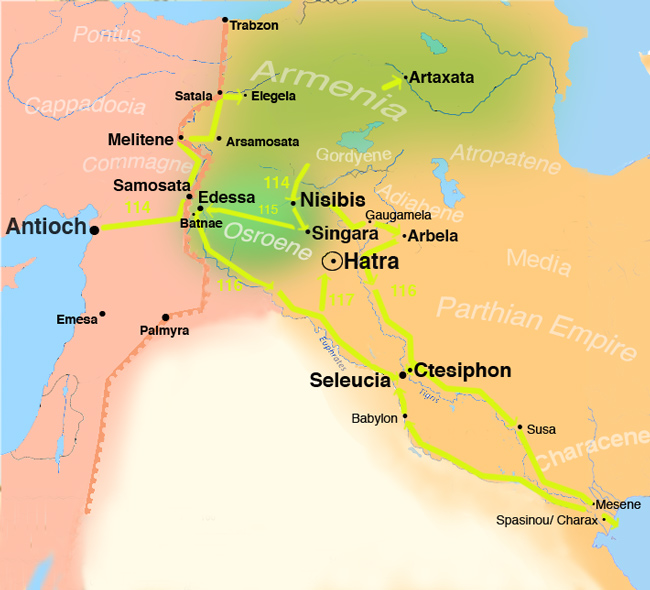
Worlds collide: Trajan's Parthian War, 114-117
Armenia bows to Rome When the Parthian king Pacorus II died in 105 two claimants emerged to fight for the throne – Osroes I in the west of the empire and Vologases III in the east. The civil war dragged on for nearly a decade and in 113, in a bid to outflank his rival, Osroes installed his nephew Parthamasiris on the Armenian throne. However the move contravened the Neroian settlement between Parthia and Rome (which gave "coronation rights" to the Roman emperor) and Osroes had underestimated the reaction in Rome. His intervention in Armenia provided Rome with a pretext for war at a time when the emperor already had designs on the east. Rejecting Parthian peace envoys while passing through Athens, Trajan arrived in Antioch early in 114. Here the army of the east, strengthened by units drawn from across the empire, was being marshalled by Hadrian – some eleven legions in all. In the spring the army moved up to the Cappadocian fortress city of Melitene and crossed into Armenian territory. Armenian resistance was light and ineffective and the legions soon took Arsamosata and reached the town of Elegeia. Here Trajan, before the audience of his legions, refused the obeisance of Parthamasiris, ended the 'Arsacid' monarchy (later restored) and annexed Armenia into the Roman empire.
Late in that campaign season Roman troops moved south from the Armenian highlands with a strategic objective in focus – the fortress city which guarded the trade route through northern Mesopotamia – Nisibis. This city, "Antioch in Mygdonia" and erstwhile Armenian southern capital, was at the time under the control of Adiabene, a Jewish client kingdom of Parthia, further east. Jews had been a major element of the population of Nisibis ever since their "Babylonian exile" in the 6th century BC. Reports Josephus:
Osroene made Roman "Mesopotamia"
Aware that a treeless waste awaited the legions as they ventured deeper into Parthian territory, Trajan sent his troops into the forests of eastern Osroene where they cut the timber for an armada of prefabricated ships. Moved by wagon onto the Tigris, these transports completely surprised the Parthians who fell back and refused to confront the invader. The war was going spectacularly well.
Adiabene made Roman "Assyria"
But in 116 the Roman armies struck south in two columns, one following the course of the Euphrates and the other the Tigris. Again, Parthian forces melted away. On the eastern flank, the Romans forces first crossed into Adiabene, capturing Gaugamela and Arbela, the capital. Adiabene was the kingdom which had embraced Judaism a century earlier during the time of Izates and his mother Helena. In 66-70 the kingdom had given support to the forces fighting Rome in Judaea. At this juncture Adiabene had dynastic links with another Parthian subject kingdom Characene which controlled trade access on the Persian Gulf. Adiabene disappeared into Roman "Assyria". The province would last barely two years. However the Christian church which shortly emerged in Adiabene called itself – and even today continues to do so – Assyrian.
Zenith in Parthia
The emperor, at this high point hailed by the Senate as "Parthicus", moved on, receiving the submission of the king of Characene at Mesene, an island in the Tigris. Standing on the shore of the Persian Gulf, Trajan famously regretted that, but for his age, he would have gone on to India. In the words of Edward Gibbon, Trajan "enjoyed the honour of being the first, as he was the last, of the Roman generals, who ever navigated that remote sea." Turning north to Babylon the Roman emperor offered sacrifice in the very room where Alexander the Great had died 400 years earlier – and no doubt savoured his own eternal glory. The campaign's success appeared to be complete and spectacular.
"Tumult of the Jews"
At this anxious moment news reached Trajan that in regions as far afield as Cyprus, Egypt and Cyrenaica (Libya) the Jews were in revolt, encouraged by Jewish agents sent from Parthia and the depletion of the local military. In Cyprus, where Herod the Great had owned copper mines, Jewish rebels were agitated by a local messianic pretender 'Artemion' and had forced Greek and Roman citizens to fight each other in gladiatorial combat. Cyrenaica was even more badly hit and the slaughter of Greek settlers had been horrendous. A Jewish messiah, ‘King Lukuas’ had been proclaimed, pagan sanctuaries and the Caesareum had been attacked and Cyrene itself almost destroyed. 4th century Christian historian Paulus Orosius records that the violence so depopulated the province of Cyrenaica that new colonies had to be established by Hadrian.
Worse yet, the Jewish insurrection spread to the recently conquered provinces. Cities with substantial Jewish populations – Nisibis, Edessa, Seleucia, Arbela – had joined the rebellion and slaughtered their Roman garrisons. The Romans were now obliged to attack cities which less than two years before had fallen so easily into their hands. Units were rushed north, under the command of Lucius Quietus, Trajan's cavalry commander. The city of Edessa, most threatening to the province of Syria and the fate of the entire army in Persia, was brutally sacked. Quietus moved so decisively in suppressing Jewish revolts across the new provinces that Trajan set him the same task in Judaea. The Jews would subsequently corrupt his name Quietus into "Kitos" and call the revolt of 115-117 the "Kitos war". Land, sea and cavalry forces, and another leading general Quintus Marcius Turbo, had to be released from the Persian front to suppress the Jewish rebellions in Egypt and Cyrenaica. Hadrian was assigned the task of pacifying Syria and Cyprus. Such was the hatred felt towards the Jews on that island, that they were, on pain of death, forbidden to set foot "even if shipwrecked."
Retreat and death of Trajan
Hadrian's "exit strategy" Hadrian received the news of Trajan's death in Antioch. It was scarcely a moment for celebration. His most pressing task was to extricate himself and the army from a hopeless military adventure. Hadrian took the unpopular but farsighted decision not only to end the war but also to abandon Trajan's eastern conquests. Hadrian's "exit strategy from Iraq" retained only a minor compensation for Rome's wasted Herculean effort. Although he abandoned the erstwhile province of Mesopotamia he installed Parthamaspates – ejected from Ctesiphon by the returning Osroes – as king of a restored Osroene. A Roman client state would now protect the Syrian flank. For a century Osroene would retain a precarious independence, sandwiched between two empires. In that period it would incubate a novel creed – Syriac Christianity – out of the ruins of Edessa. It would also produce the first Christian monarch when Abgar IX (179-186) gave state sponsorship to a devotion which wrapped divine endorsement around his precarious earthly authority. The device would be copied by the client kings of Armenia – and soon after by Constantine, Emperor of Rome.
What
happened to Egyptian Jewry after 118 AD ?
Notable among them was a young man – he would have been about eighteen at the time of the insurrection – studying in the very city of Alexandria and witness to the carnage: Valentinus. Another was Basilides. Following in the tradition of synthesis and syncretism of long-standing in Alexandria (e.g. Philo a generation earlier), these 'proto-Christian theorists', Valentinus and Basilides competed against each other, had their own cult followings, and produced their own 'gospels'. And then ...
"Mark": Bringing the Celestial Superjew Down to Earth It is intriguing
to note that two proto-Christian theoreticians Ignatius and Saturninus had
been in Antioch at the same time as Hadrian. And lo! and behold,
a revised gospel was to subsequently appear:
Hadrian moved
his court to Alexandria. The Jews of Jerusalem sent a delegation
to him, led by the aged priest Akiba, but to little avail. Hadrian despised
the Jews for their insularity and arrogant claims for a single
concept of the divine. Their treachery in the recent war had hardened his contempt.
One of his first acts as emperor in 118 was to promote the
pacifier of the Jews of Egypt, Quintus Marcius Turbo, to the key
governorship of Pannonia and Dacia. For twenty years there would be hostility between the enlightened
Roman monarch and the zealots of Jehovah – with consequences
beyond imagination.
Sources:
Copyright © 2004, 2008
by Kenneth Humphreys.
|
||||||||||||||||||||||||||||||||||||||||||||||||||